HIRING GUIDE
Interview Evaluation Form and Scorecard: Free Word, PDF and Excel
Rate candidates against the same job criteria, write down the evidence, and compare the panel's scores in a weighted Excel scorecard.
FREE DOWNLOAD · NO SIGNUP
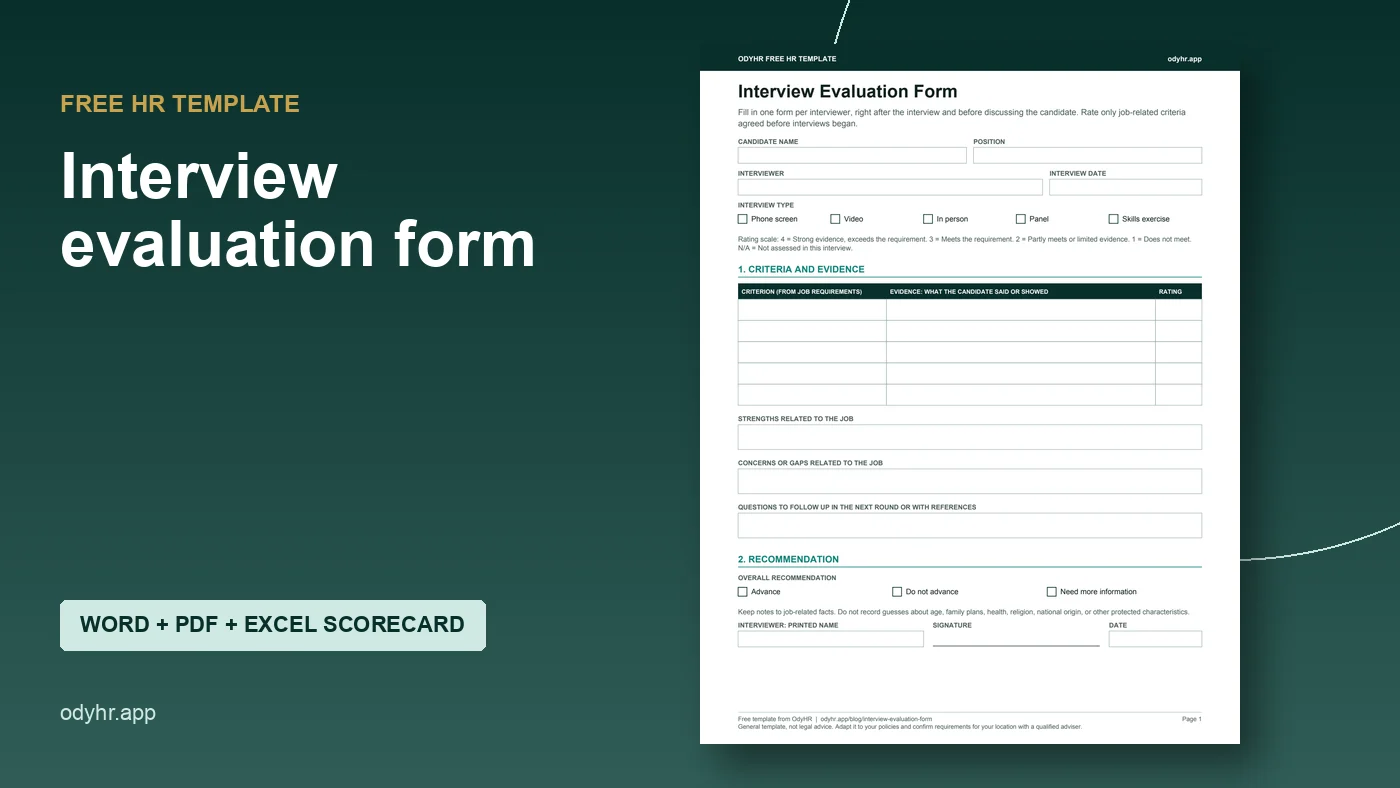
Interview evaluation form + scorecard
One-page interview form for each interviewer, plus an Excel scorecard that weights criteria and ranks candidates.
Important: This guide provides general operational information, not legal advice. Employment requirements vary by location, industry, workforce, and situation. Confirm current requirements with qualified HR or legal professionals.
WHAT YOU GET
Rate every candidate against the same job criteria
An interview evaluation form lets each interviewer rate a candidate against criteria agreed before interviews start, with the evidence behind each rating. Used consistently, it makes hiring decisions easier to compare and easier to explain.
The free download has three files:
- Interview evaluation form (Word and fillable PDF, one page): candidate and interview details, a 1 to 4 rating scale, a criteria table with an evidence column, strengths, concerns, follow-up questions and a recommendation.
- Interview scorecard (Excel): enter up to eight weighted criteria and six candidates. It calculates a weighted score and rank for each candidate, and leaves out criteria that were not assessed instead of scoring them as zero.
Both include a fictional example.
PREVIEW
The scorecard, filled in
Fictional ratings from the example tab. Weight 2 marks the criteria the panel cared about most. Candidate B was not asked about availability, so that blank is left out of B’s score.
| Criterion | Weight | Candidate A | Candidate B | Candidate C |
|---|---|---|---|---|
| Scheduling and calendar experience | 2 | 3 | 4 | 2 |
| Handles a difficult caller (role play) | 2 | 3 | 3 | 2 |
| Accurate data entry (timed exercise) | 1 | 2 | 4 | 3 |
| Explains a policy clearly | 1 | 3 | 3 | 2 |
| Available for the posted schedule | 1 | 4 | not assessed | 4 |
| Uses a checklist to close out the day | 1 | 2 | 3 | 2 |
| Weighted score (1 to 4) | 2.88 | 3.43 | 2.38 | |
| Rank | 2 | 1 | 3 |
Fictional example. The panel asked Candidate B one more question before deciding.
HOW TO USE IT
A structured interview in five steps
- 01
Pick the criteria from the job. Four to eight things the person must be able to do, taken from the job description. Weight the two or three that matter most.
- 02
Write the questions ahead of time. Ask every candidate the same core questions for each criterion. Follow-ups are fine; changing the test is not.
- 03
Rate alone, right after the interview. Each interviewer fills in the form before talking to the others, so one strong opinion does not set everyone’s score.
- 04
Write the evidence. “Described rebuilding a 3-provider schedule after a sick call, step by step” supports a 4. “Seemed sharp” does not support anything.
- 05
Debrief with the scorecard. Agree on one rating per criterion, enter it, and use the ranking to structure the discussion. Record the reason for the final decision.
If you review written applications before interviews, the application review rubric uses the same idea for the screening stage. Agreeing on criteria with the hiring manager first is covered in the hiring manager intake checklist.
KEEP IT JOB-RELATED
What not to write down
Interview notes can be requested in a dispute. Keep them about the job. Do not record guesses or comments about age, pregnancy or family plans, health or disability, religion, national origin, race, sex, or other protected characteristics. The form says this on the page so every interviewer sees it.
The U.S. Office of Personnel Management describes structured interviews as asking all candidates the same job-related questions and rating answers on a defined scale. This form follows that approach. It is not a validated assessment and does not by itself make a hiring decision fair or lawful.
FROM APPLICANT TO FIRST DAY
Where OdyHR fits
Scorecards work best when they stay attached to the candidate. Spreadsheets on someone’s laptop and printed forms in a folder tend to get lost between the interview and the offer.
OdyHR brings applications from your careers page into one hiring workflow where your team can review candidates, track interviews and offers, and hand a hire straight into onboarding. It does not score candidates for you or make hiring decisions.
QUESTIONS
Interview evaluation FAQ
What should an interview evaluation form include?
The candidate, position, interviewer and date; the criteria you agreed on before interviews; a rating scale; the evidence behind each rating; strengths, concerns and a recommendation.
Should I use a 1 to 4 or a 1 to 5 scale?
Either works. A 4-point scale has no middle option, which pushes interviewers to decide whether a candidate meets the requirement. Whatever you choose, define each number before interviews start.
How is the weighted score calculated?
Each rating is multiplied by its weight, added up, and divided by the total weight of the criteria that were actually rated. A criterion left blank does not pull the score down.
Should the highest score always get the offer?
No. The score organizes the discussion. References, a missing criterion or a close result may change the decision. Write down the reason either way.
How long should I keep interview notes?
Keep them with the hiring record. EEOC rules generally require covered employers to keep hiring records for at least one year, and longer if a charge or lawsuit is filed. State rules may add more.
AUTHORITATIVE REFERENCES