HIRING OPERATIONS GUIDE
Hiring Manager Intake Meeting Checklist
Run a hiring manager intake meeting that clarifies the role, recruiting constraints, decision owners and next steps before applications arrive.
Important: This guide provides general operational information, not legal advice. Employment requirements vary by location, industry, workforce, and situation. Confirm current requirements with qualified HR or legal professionals.
A hiring manager intake meeting should end with a clear description of the work, agreed recruiting constraints and named owners for the next decisions. When those details remain scattered across conversations, a job can go live while the people reviewing applications still disagree about what they need.
Use this checklist before opening a role or restarting a search whose scope has changed. The output is a short decision record that the hiring manager, recruiting owner and other approvers can use throughout the search.
This is general operational guidance, not legal advice or a validated selection method. Have qualified HR or legal advisers review requirements and hiring procedures for your organization and location.
Prepare the decisions before the meeting
Invite the hiring manager and the person coordinating recruiting. Include an additional approver only when their input is needed, such as a budget owner or a specialist who understands the work. Give people the current role description and a short list of unresolved questions in advance.
Bring these inputs:
- The business reason for the opening and the work that needs an owner
- The current or proposed role description
- Approved headcount, compensation information and working arrangements
- The target start date and the reason behind it
- Any constraints on interviewer availability or onboarding capacity
- Questions carried forward from an earlier search for the role
Label each input as approved, proposed or still unknown. An attractive draft salary range is not an approved range simply because it appears in the meeting notes. Assign unresolved approvals rather than letting assumptions enter the public listing.
Start with the actual work
Ask the manager to describe a typical assignment, an important recurring responsibility and an example of a decision the employee will need to make. Then identify the knowledge and skills those tasks require.
The U.S. Office of Personnel Management describes job analysis as examining job tasks, the competencies needed to perform them and the relationship between the two. That is a useful starting principle for the intake discussion. A short kickoff meeting does not replace a formal job analysis when one is required. OPM job analysis guidance
Useful questions include:
- What work will this person take over, and from whom?
- Which responsibilities are essential to the opening?
- What would an acceptable early work result look like?
- Which decisions can the person make independently?
- What support, supervision or training will be available?
Write concrete answers. “Coordinates customer requests from receipt to an assigned resolution owner” gives the recruiting team something more usable than “excellent multitasker.” Review any essential duties and selection requirements with the appropriate subject owner.
Separate entry requirements from planned learning
For each proposed requirement, ask why it is needed when the person starts. If the team expects to teach a particular internal process, record the learning plan and owner rather than automatically making prior knowledge of that process a screening requirement.
OPM's selection guidance distinguishes competencies needed on entry from those expected to develop through experience or training after selection. Its guidance is written for federal personnel assessment; use the distinction to examine your assumptions, with role-specific HR review. OPM guidance on entry competencies
This discussion produces an approved set of requirements. The application-review rubric guide covers the next step: deciding what evidence reviewers will consider and how they will record uncertainty.
Use a short agenda with a decision for each section
For a straightforward opening, the following 45-minute agenda is an illustrative starting point. Give a complex or unfamiliar role more preparation and discussion time.
1. Opening and approval status, 5 minutes. Confirm why the role exists and which decisions are already authorized.
2. Work and requirements, 10 minutes. Agree on the core responsibilities, entry requirements and planned learning.
3. Recruiting constraints, 10 minutes. Confirm approved location, schedule, compensation information and realistic timing.
4. Review and communication owners, 10 minutes. Name who reviews applications, coordinates interviews, makes decisions and communicates with candidates.
5. Open questions and next steps, 10 minutes. Assign each unresolved item and decide what must be settled before the opening is published.
The duration is an editorial suggestion, not a research-backed standard. The useful test is whether the meeting resolves the decisions needed for the next stage.
Make ownership specific enough to use
Agree on how applications reach the reviewer and who covers an absence. Decide when the first review will happen and how the recruiting owner should raise a delay. Use dates or a realistic review rhythm that the team can support.
Keep approval authority separate from coordination. The person arranging an interview may not be authorized to change the role, negotiate compensation or approve an offer. Record the appropriate decision-maker for each of those actions.
Before anything goes live, use the company-website job-posting checklist to check the listing and application path. Assign a person to confirm the approved role details match the published version.
Work through a fictional disagreement
A support manager wants a coordinator who can start quickly and already knows the company's internal request-routing process. The recruiting owner points out that this process is specific to the company.
During intake, the manager describes the actual work: receiving requests, identifying missing information and routing each request to the right team. The group agrees which relevant experience should be assessed, while the manager owns training on the internal routing guide.
A second question remains open. The proposed evening schedule has not been approved. The recruiting owner records the scheduling decision, its approver and a due date. Publication waits for that material detail rather than advertising a working arrangement the team may later change.
This fictional example illustrates a decision process. It is not a customer result or evidence that a particular requirement predicts job performance.
Keep one current intake record
Use the following fields as a practical meeting template:
- Opening, hiring manager and recruiting owner
- Reason for the role and core work responsibilities
- Approved entry requirements and planned learning
- Approved location, schedule and compensation information
- Target timing and known dependencies
- Reviewers, decision-makers and candidate-communication owner
- Unresolved decisions, approving owners and due dates
- Conditions to meet before publication
- Record date, approver and reason for later changes
When a material requirement changes during the search, update the record and have the hiring owner determine how to handle affected listings, communications and reviews consistently. Avoid making a quiet change that leaves different reviewers using different versions.
For ongoing coordination, connect open decisions to the weekly hiring-to-onboarding review. The intake record gives that review its starting point: what was agreed, who owns the work and what still needs a decision.
Put the agreed process into practice
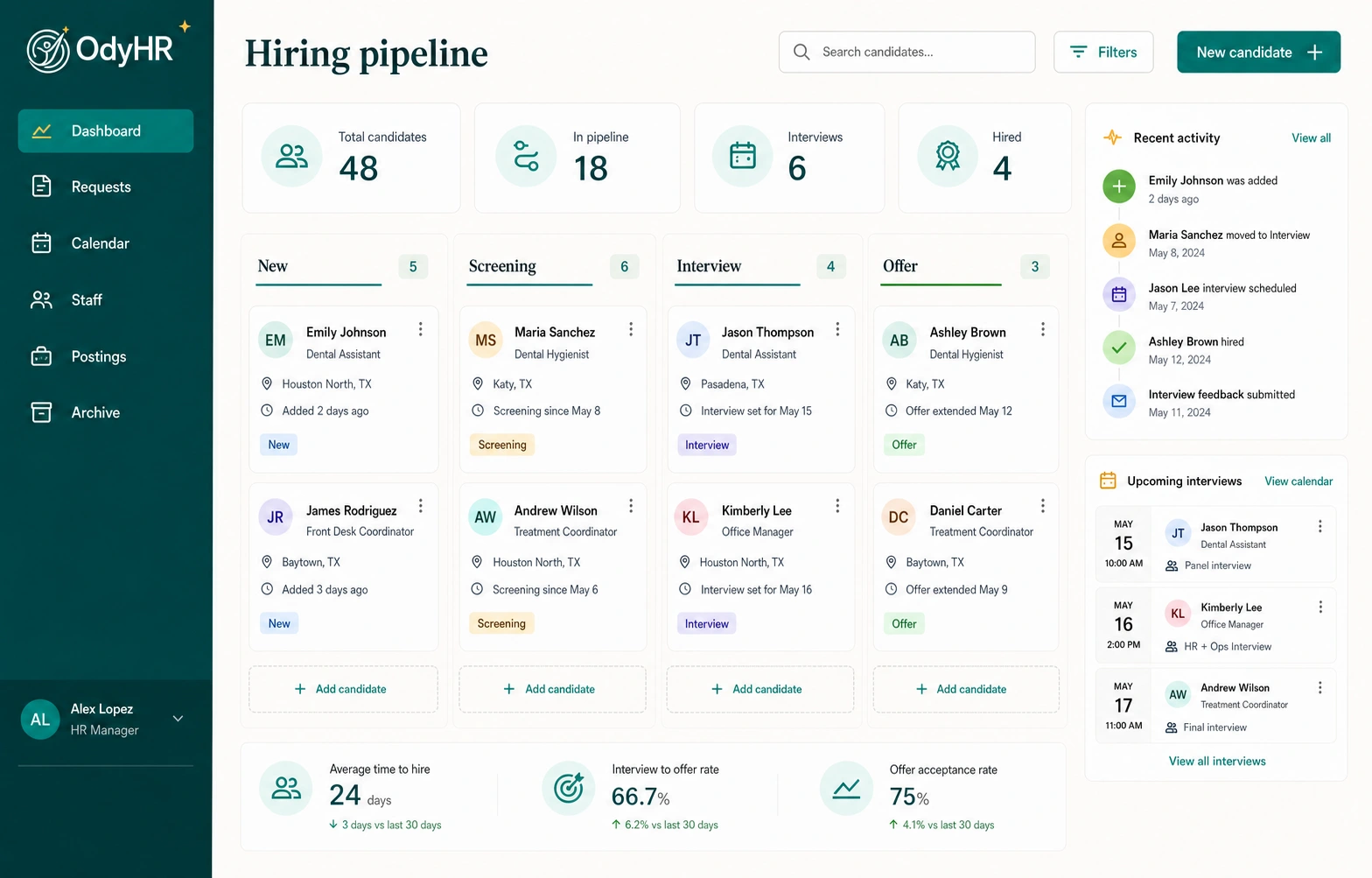
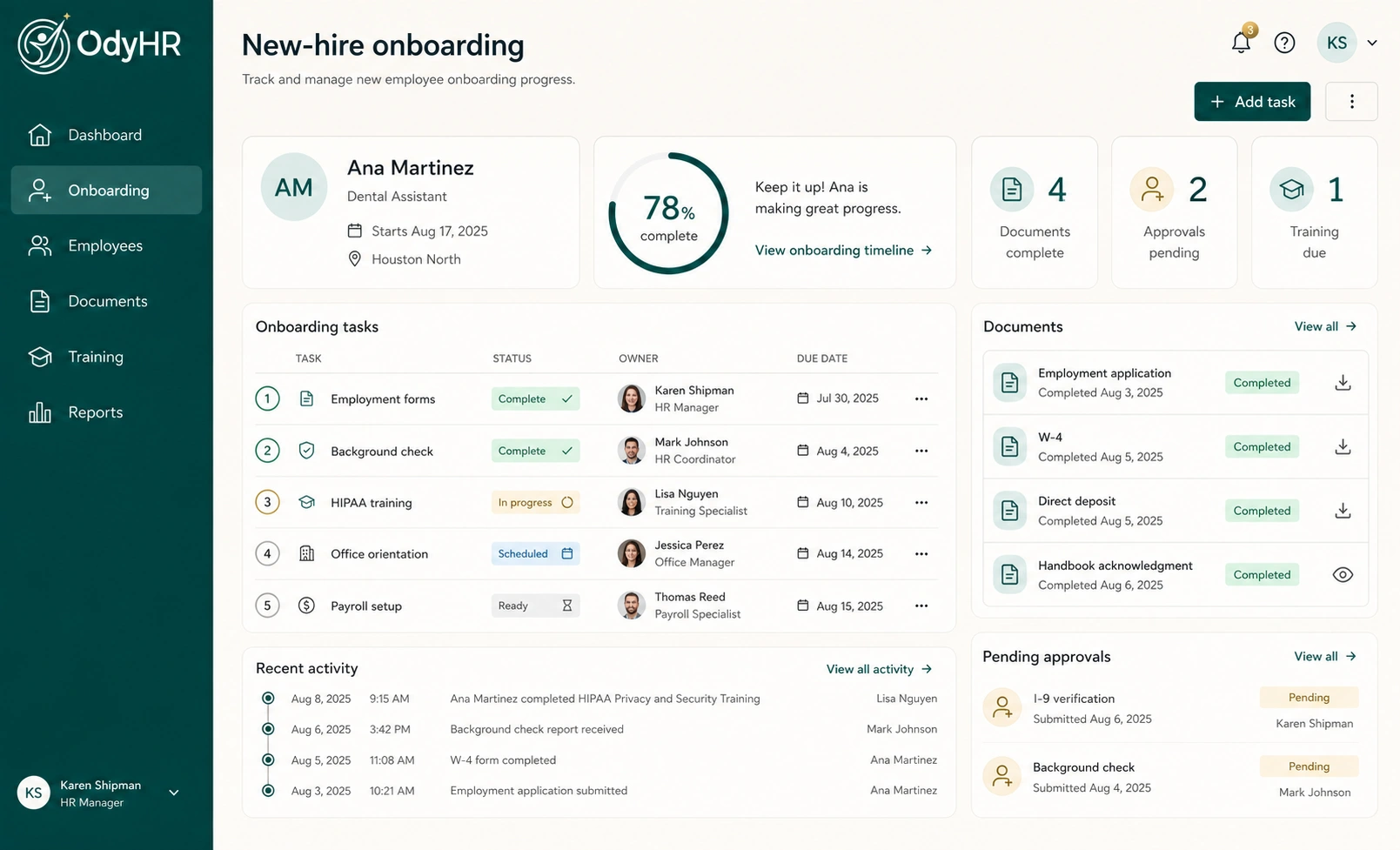
If application ownership or the handoff into onboarding is unclear, talk through your workflow with OdyHR. Bring a fictional example of the steps and people involved so you can discuss application-review and onboarding-progress coordination without sharing confidential candidate records.
AUTHORITATIVE REFERENCES