TRAINING GUIDE
HIPAA Training Log for Dental Staff: What to Record and How Long to Keep It
What a dental office HIPAA training log should hold, who has to be trained and when, and why the records stay on file for six years.

Important: This guide provides general operational information, not legal advice. Employment requirements vary by location, industry, workforce, and situation. Confirm current requirements with qualified HR or legal professionals.
A HIPAA training log shows who in your office was trained on your privacy and security policies, when, on what, and how you know they finished. The HIPAA Privacy Rule requires dental practices to train their workforce, document that the training happened, and keep that documentation for six years. If an investigator ever asks "was this person trained?", the log is your answer.
This is general information, not legal advice.
Who has to be trained, and when
The training rule is in 45 CFR 164.530(b). A covered entity must train all members of its workforce on its policies and procedures for protected health information, as needed for each person to do their job.
"Workforce" is broader than payroll. Under 45 CFR 160.103, it includes employees, volunteers, trainees and other people whose work is under the practice's direct control, whether or not you pay them. In a dental office that means dentists, hygienists, assistants, front desk and billing staff, and often temps and students.
The rule sets three timing points:
- Existing staff: trained by the practice's original compliance date. For most offices the real question now is whether everyone on today's roster has a record.
- New hires: trained within a reasonable period of time after they join.
- Policy changes: anyone whose job is affected by a material change in your policies or procedures must be trained within a reasonable period after the change takes effect.
The rule does not define "reasonable" in days. Pick a number, write it into your policy (for example, before the person first works with patient records), and follow it.
The Security Rule adds a separate requirement. 45 CFR 164.308(a)(5) requires a security awareness and training program for all members of the workforce, including management. Track it in the same log as a separate topic.
HIPAA does not set a fixed annual retraining interval. Many practices train every year anyway because a regular history is easier to show. That is a practice choice, so write it down as one.
What each log entry should hold
The rule says you must document that training was provided. It does not prescribe a form. A useful entry answers who, what, when, how and proof:
- Name of the person trained
- Role (hygienist, front desk, dental assistant, temp, and so on)
- Date the training was completed, not just the date it was assigned
- Topic and version, for example "Privacy policies, v2026.1" or "Security awareness: phishing, March 2026"
- Method: in person, video, online course, or a one-on-one review
- Trainer or source: the person who led it, or the course provider
- Acknowledgment: a signature, initials or electronic sign-off confirming the person completed it
- Reason: new hire, annual refresh, or policy change, so you can show the timing rule was met
The version column matters. When you update a policy, the log should show who has been trained on the new version. Keep the signed acknowledgment itself in the employee file and note where it is stored. Our guide on how to organize employee files covers a simple structure.
How long to keep HIPAA training records
Six years. 45 CFR 164.530(j)(2) requires a covered entity to keep required documentation for six years from the date it was created or the date it was last in effect, whichever is later. Training records fall under this because the training rule itself requires them to be documented. The Security Rule has the same six-year period for its documentation at 45 CFR 164.316(b)(2).
Two practical points. The clock does not stop when someone leaves, so do not purge a former hygienist's training records with the rest of her file without checking the date. And keep old policy versions: if a row says "Privacy policies v2023.2", you should be able to produce that version. Six years is the HIPAA floor, not a deletion date.
Common gaps in dental offices
Most practices do train their people. The problems are usually in the record.
- Temps and fill-in staff. A temp hygienist working under your direction is part of your workforce, but often skips orientation. A short, dated acknowledgment of your key policies on day one closes the gap.
- Mid-year hires. If your office trains everyone in January, the hygienist hired in June can go eleven months without a record. Tie HIPAA training to the onboarding checklist, not the calendar. Our employee onboarding checklist and the Texas dental office new hire paperwork checklist both show where it fits in the first week.
- Front desk turnover. The front desk handles the most patient information and often turns over fastest. Check every new name against the log.
- Training with no proof. A staff meeting is not a record without a date, an agenda and a sign-in sheet.
- Policy changes with no retraining. If you changed how you handle records requests or switched practice software, affected staff need a dated entry.
A simple log layout
One row per person, per training. A spreadsheet works fine for a single office:
| Name | Role | Date completed | Topic and version | Method | Trainer or source | Reason | Acknowledgment | Proof stored at |
|---|---|---|---|---|---|---|---|---|
| Maria Lopez | Hygienist | 2026-06-09 | Privacy policies v2026.1 | In person | Office manager | New hire | Signed | Employee file > Training |
| Maria Lopez | Hygienist | 2026-06-09 | Security awareness 2026 | Online course | Course provider | New hire | Certificate | Employee file > Training |
| Sam Reed | Front desk (temp) | 2026-08-04 | Key policies summary v2026.1 | One-on-one | Office manager | Temp start | Initialed | Temp folder 2026 |
Fictional example rows.
Add a new row each time instead of overwriting the old date. If you want a ready-made spreadsheet, the free staff training record template has these columns and flags renewals that are coming due. To plan which roles need which topics, use the employee training matrix template.
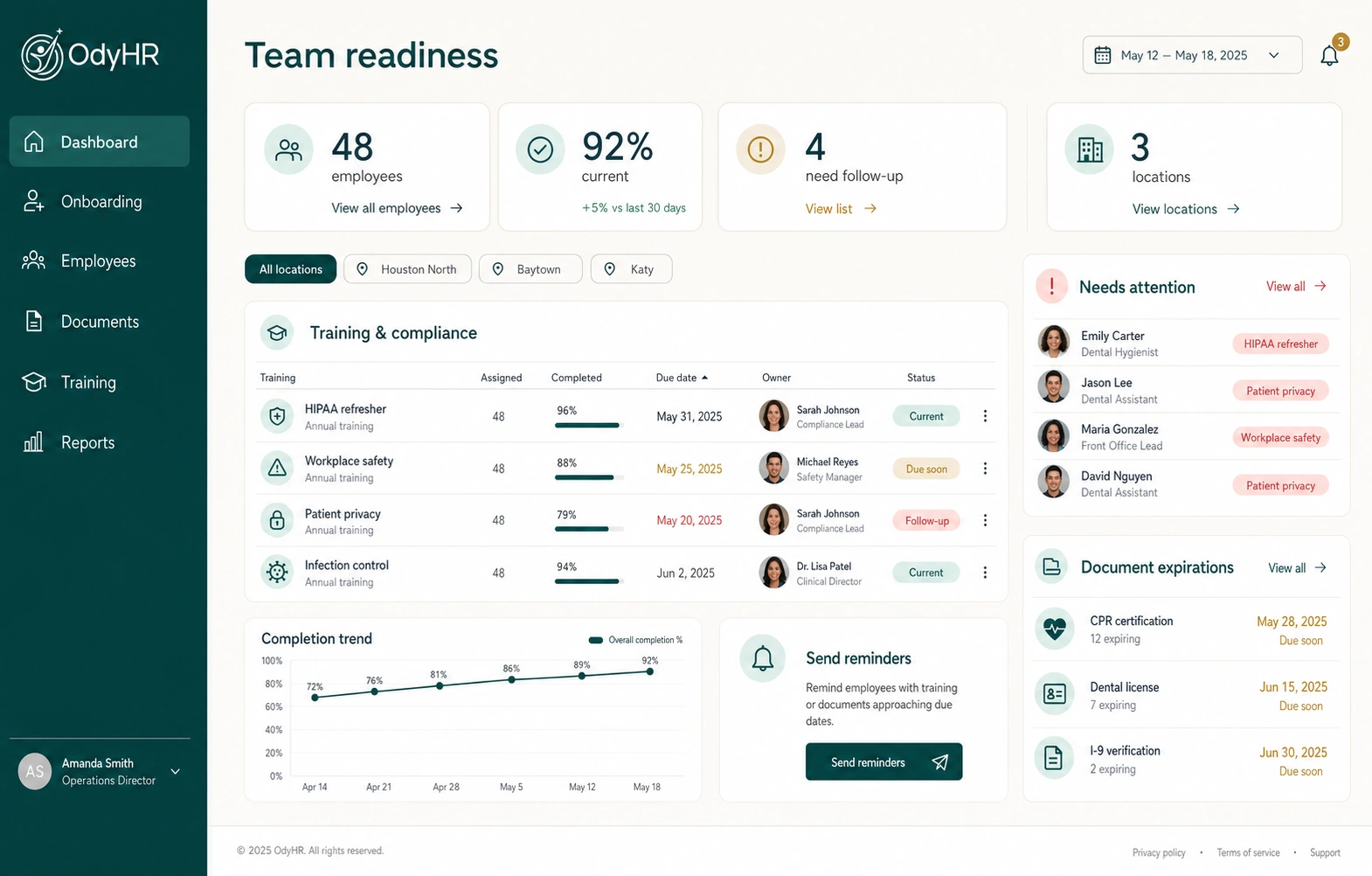
Once a month, compare the log to your staff list and check that the latest policy version shows up for everyone it affects. If you would rather not maintain a spreadsheet, OdyHR records training completion and signed acknowledgments on each employee's record, so the log builds itself as people finish.
Questions
How long do you have to keep HIPAA training records?
Six years from the date the record was created or last in effect, whichever is later, under 45 CFR 164.530(j). Keep records for former employees for the full period too.
Does HIPAA require annual training for dental staff?
The rule does not set a yearly interval. It requires training for new workforce members within a reasonable time, and for affected staff when policies materially change. Many practices train annually as their own policy, which makes the history easier to show.
What should a HIPAA training log include?
The person's name and role, the completion date, the topic and policy version, how the training was delivered, who delivered it, why it was given, and a signature or electronic acknowledgment, plus where the proof is stored.
AUTHORITATIVE REFERENCES
Sources used for this guide
- 45 CFR 164.530, Administrative requirements (training, documentation, retention)eCFR (Office of the Federal Register) ↗
- 45 CFR 160.103, Definitions (workforce)eCFR (Office of the Federal Register) ↗
- 45 CFR 164.308(a)(5), Security awareness and trainingeCFR (Office of the Federal Register) ↗
- 45 CFR 164.316(b)(2), Security Rule documentation retentioneCFR (Office of the Federal Register) ↗