COMPLIANCE GUIDE
Year-End HR Checklist for Dental Offices
A December HR checklist for dental and medical offices: W-2 and 1099 deadlines, W-4s, PTO carryover, holiday pay, I-9 cleanup, OSHA logs and expiring certifications.

Important: This guide provides general operational information, not legal advice. Employment requirements vary by location, industry, workforce, and situation. Confirm current requirements with qualified HR or legal professionals.
December in a dental office is already full: patients using their insurance benefits before they reset, staff taking time off, holiday hours to post. The HR side of year-end tends to get pushed to January, when the first deadlines are already close.
This checklist covers what to do in December so January is quiet. It's general information for practices, not tax or legal advice. Check dates with your payroll provider or accountant, since they file most of these forms for you.
1. Get addresses and names right before W-2s go out
W-2s go to the address and name in payroll. A wrong address means a form that never arrives and an employee asking for a copy in March.
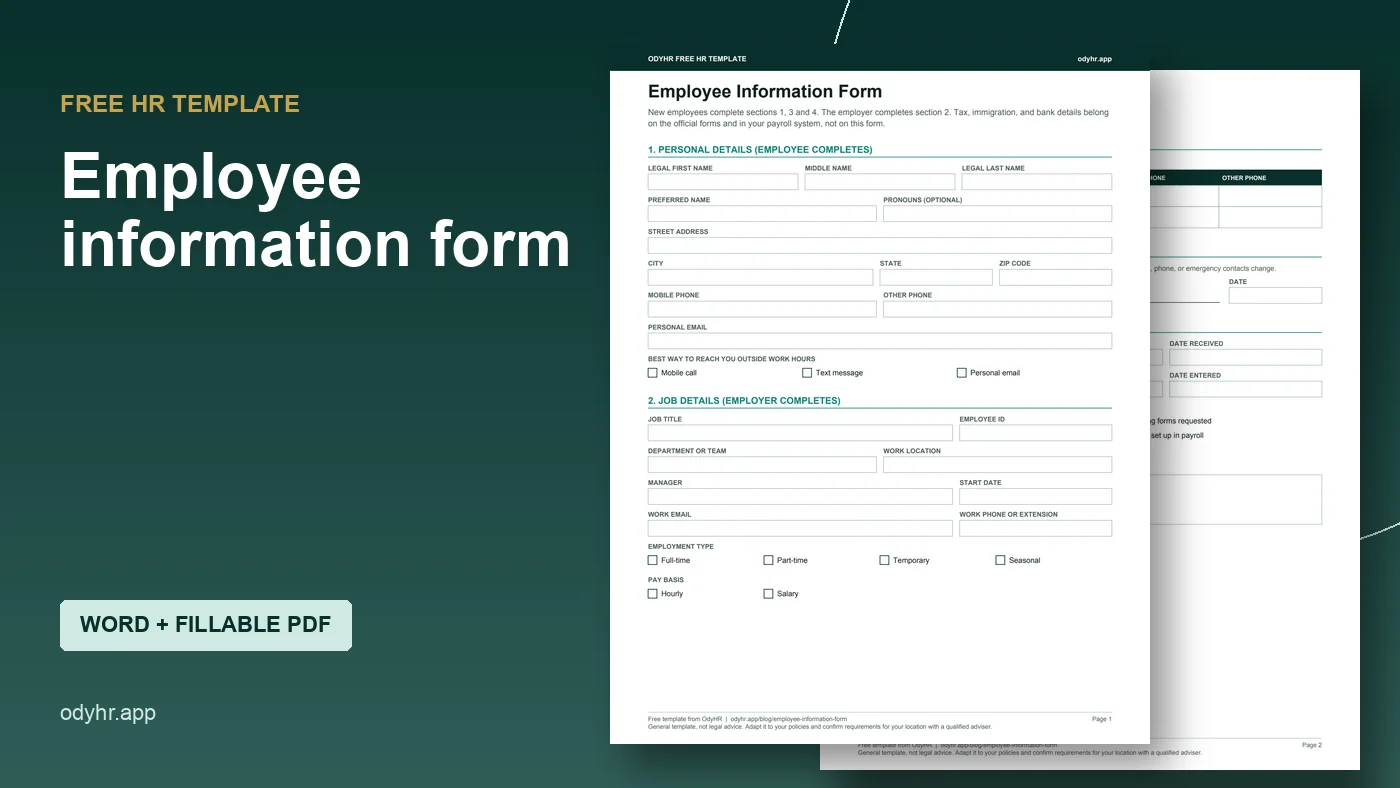
- Ask every employee to confirm their mailing address, legal name and Social Security number spelling in December. An employee information form makes this a two-minute task.
- Collect the same for anyone who left this year. Former employees still get a W-2.
- Update payroll before your provider runs year-end.
2. Know the January deadlines
For wages paid in 2026, the main federal deadlines fall at the end of January 2027.
- Form W-2: give copies to employees and file with the Social Security Administration by January 31. IRS: Employment tax due dates
- Form 1099-NEC: file with the IRS and give a copy to each independent contractor you paid by January 31. In dental offices that can include a contract hygienist, a temp agency worker paid directly or an outside IT or billing contractor. IRS: Instructions for Forms 1099-MISC and 1099-NEC
- Form 940 (federal unemployment tax): due January 31, or 10 days later if you deposited all of the tax on time. IRS: Employment tax due dates
January 31, 2027 falls on a Sunday. When an IRS due date lands on a weekend, it generally moves to the next business day, but confirm the exact date with your payroll provider. There is no automatic extension for W-2s or 1099-NECs, so don't plan on one. IRS: Employment tax due dates
3. Collect contractor W-9s now
If you paid a contractor this year and don't have a Form W-9 on file, ask for it in December, while they still answer your emails. You need their legal name and taxpayer ID to file the 1099-NEC.
4. Remind staff about W-4s
Two groups need a nudge:
- Anyone who claimed exempt from withholding. An exempt W-4 only lasts for the calendar year. To stay exempt, they must give you a new one by February 15. If they don't, the IRS says to withhold as if they'd checked Single or Married filing separately with no other entries. IRS Publication 15
- Anyone whose life changed. Marriage, a new baby or a second job are good reasons to update a W-4. You can't give tax advice, but you can remind everyone the form exists.
5. Check your PTO policy before the year turns
This is where most year-end questions come from: "Do my unused days roll over?" and "Do I get paid for them if I leave?"
In Texas, the answer is whatever your written policy says. The Texas Workforce Commission says vacation, holiday and sick pay are owed only when a written policy or agreement provides for them, and the employer sets how they're earned, used and whether unused time is paid out. Texas Workforce Commission: Texas Payday Law
What to do in December:
- Reread your PTO policy. Does unused time carry over, get capped or reset on January 1?
- Tell staff now how many days they have left and what happens to them. A surprise "use it or lose it" in the last week of December leaves the schedule with holes.
- Apply the policy the same way to everyone.
Practices outside Texas should check their own state's rules, since some states treat earned vacation differently.
6. Settle holiday pay and holiday hours
Federal law doesn't require paid holidays. The Department of Labor says pay for time not worked, including holidays, is a matter of agreement between the employer and employee. U.S. Department of Labor: Holiday pay
So holiday pay comes down to your policy. Before the holidays:
- Post the office closure dates and holiday hours.
- Say which days are paid holidays and who qualifies (for example, full-time only, or after 90 days).
- Remember that hours worked on a holiday still count toward overtime for nonexempt staff if the week goes over 40 hours. U.S. Department of Labor: Overtime pay
7. Clean up I-9s and old files
Year-end is a good time to shred what you no longer have to keep, and to find what's missing.
- You must keep each employee's Form I-9 for three years after the hire date or one year after employment ends, whichever is later. Once a former employee is past that date, the form can be destroyed securely. USCIS: I-9 retention
- Check that every current employee has a completed I-9 on file.
- Our hiring record retention checklist covers what else to keep and for how long.
8. OSHA injury logs: dental offices are usually exempt
Many offices post OSHA's Form 300A summary every February. Most dental offices don't need to. Offices of dentists are on OSHA's list of partially exempt industries, so they don't have to keep the injury and illness logs unless OSHA or the Bureau of Labor Statistics asks in writing. OSHA: Partially exempt industries
Two things still apply to every practice:
- Serious injuries must still be reported to OSHA: a work-related death, an in-patient hospitalization, an amputation or the loss of an eye. OSHA: Partially exempt industries
- Other OSHA rules, like bloodborne pathogens training and exposure records, don't go away because of the recordkeeping exemption.
Medical practices have different industry codes, so check the list for yours.
9. Look ahead at certifications and training
Check what expires in the first quarter, while there's time to book classes.
- BLS and CPR cards: list anyone whose card expires January through March. Our BLS and CPR tracking guide covers timing and Texas board rules.
- HIPAA training: make sure this year's sessions are logged with dates and signatures. See our HIPAA training log guide.
- Licenses and registrations renewing next year.
10. Close out the year in each employee file
- File signed policy acknowledgments, write-ups and reviews from this year.
- Note any open items: a review that didn't happen, a missing signature, a card copy you never got.
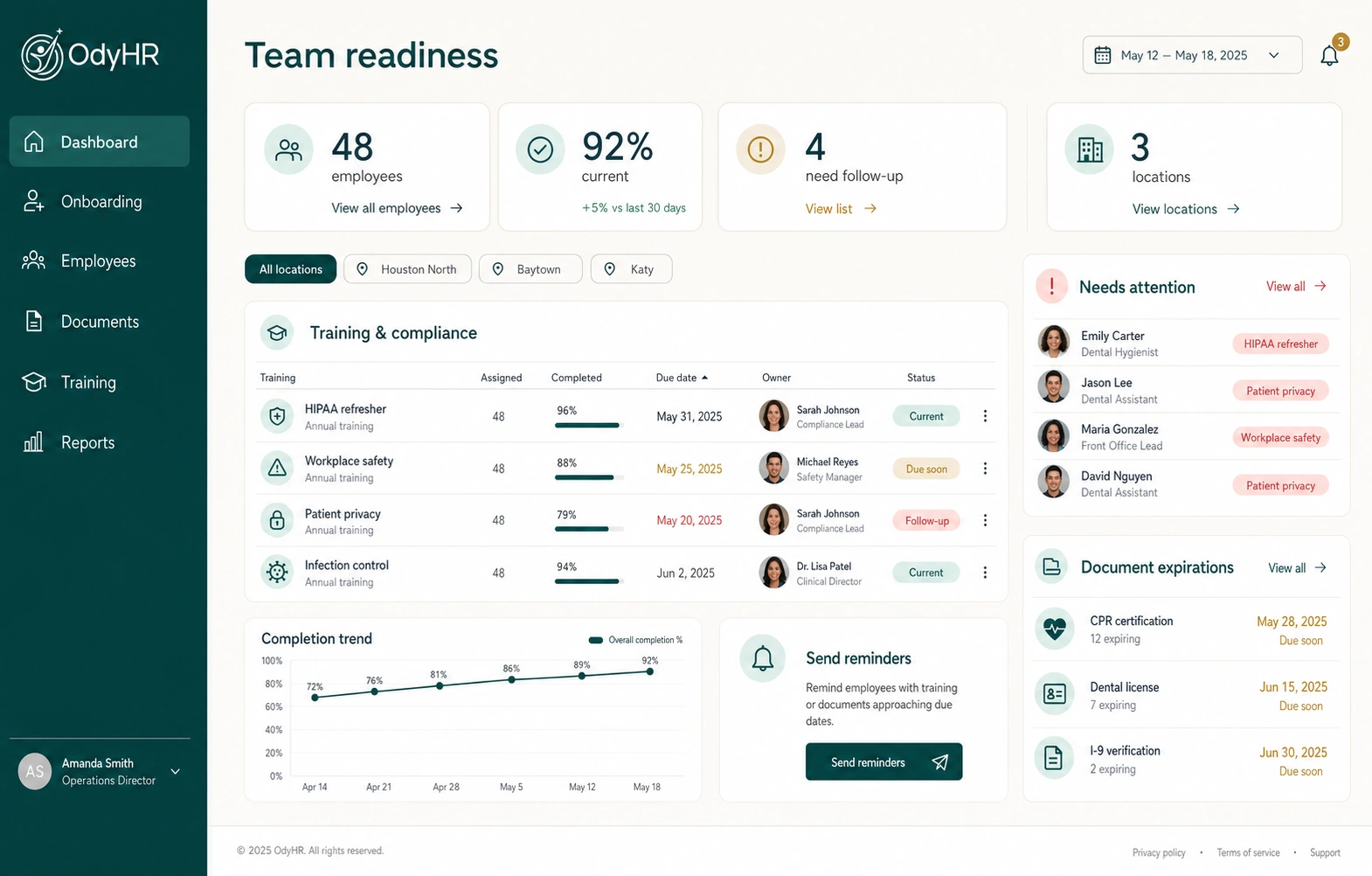
If you keep employee records in OdyHR, training dates, certification expirations and signed documents sit on each person's record, so this step is mostly a review rather than a hunt.
Questions
When are W-2s due to employees?
By January 31 for wages paid the year before. For 2026 wages, January 31, 2027 falls on a Sunday, so confirm the exact date with your payroll provider.
Do Texas employers have to pay out unused PTO?
Only if your written policy says so. The Texas Workforce Commission says vacation and holiday pay are owed only when a written policy or agreement provides for them.
Do dental offices have to post OSHA Form 300A?
Usually not. Offices of dentists are partially exempt from OSHA's injury and illness recordkeeping unless OSHA or BLS asks in writing. Serious injuries must still be reported.
How long do I keep an I-9 after someone leaves?
Three years after the hire date or one year after employment ends, whichever is later.
AUTHORITATIVE REFERENCES
Sources used for this guide
- Employment tax due datesInternal Revenue Service ↗
- Instructions for Forms 1099-MISC and 1099-NECInternal Revenue Service ↗
- IRS Publication 15Internal Revenue Service ↗
- Texas Payday LawTexas Workforce Commission ↗
- Holiday payU.S. Department of Labor ↗
- Overtime payU.S. Department of Labor ↗
- I-9 retentionU.S. Citizenship and Immigration Services ↗
- Partially exempt industriesOccupational Safety and Health Administration ↗