WORKPLACE SAFETY GUIDE
Workplace First Aid Supplies Checklist: Access, Restocking and Shift Coverage
OSHA requires adequate first aid supplies but no fixed kit list. Use this checklist to decide contents, check access on every shift, and assign restocking.

Important: This guide provides general operational information, not legal advice. Employment requirements vary by location, industry, workforce, and situation. Confirm current requirements with qualified HR or legal professionals.
OSHA requires general industry employers to keep adequate first aid supplies readily available, but it does not publish a mandatory kit list. That leaves you to decide what each kit holds, where it is kept, who checks it, who restocks it, and who on each shift knows how to use it. This checklist walks through those decisions so a kit is stocked and reachable when someone actually needs it.
This is an administrative planning guide, not first aid instruction, legal advice, or a complete safety assessment. Have the person responsible for safety at your business, or a qualified safety professional, confirm which rules apply and what your response arrangements should be.
What OSHA requires for general industry
The general industry rule is 29 CFR 1910.151. Three parts matter for supplies:
- Supplies: "Adequate first aid supplies shall be readily available."
- Trained people: if there is no infirmary, clinic or hospital in near proximity that is used to treat all injured employees, one or more people must be adequately trained to render first aid.
- Eyewash and drench: where eyes or body may be exposed to injurious corrosive materials, suitable facilities for quick drenching or flushing must be provided within the work area for immediate emergency use. A kit does not satisfy this.
The standard does not list kit contents. Its Appendix A is non-mandatory and points to ANSI Z308.1 as an example of minimal contents for a generic kit. In a 2019 interpretation letter, OSHA said it reads "adequate" to include the bleeding control items listed for ANSI Class A kits, and it expects Class B items, including tourniquets, where the risk of serious injury is high.
If you operate in a state with its own OSHA-approved State Plan, that plan must be at least as effective as federal OSHA and may set its own requirements. Check your state plan before treating the federal rule as the whole answer.
Construction sites follow a separate rule
Construction work falls under 29 CFR 1926.50, which is more specific. First aid supplies must be easily accessible when required. Kit contents must be in a weatherproof container with individually sealed packages for each type of item. The employer must check kits before they are sent out on each job and at least weekly on each job so used items are replaced.
That weekly check is a construction requirement. Some offices and shops choose a similar routine, but it is not a general industry rule, so do not describe it to employees as one. The construction standard also has its own trained-person and corrosive-flushing provisions, so have your safety owner confirm which standard covers each site.
Decide what goes in each kit
OSHA's first aid program guide advises giving one specific person responsibility for choosing the types and amounts of supplies and for maintaining them. It also says supplies should reflect the kinds of injuries that actually occur.
- Review your OSHA 300 log, 301 reports, workers' compensation reports, or other injury records to see what happens at each location.
- Check which ANSI/ISEA Z308.1 edition and kit class your supplier fills to. The standard is revised from time to time, and a box with a familiar label may not match your hazards.
- Add supplies for unusual hazards, larger crews, or multiple buildings. OSHA suggests consulting the local fire and rescue service or medical professionals when needs are unique or changing.
- Consider whether an automated external defibrillator (AED) belongs in your plan. The OSHA guide recommends considering one.
- Write an approved contents list for each location so reorders do not quietly change what the kit holds.
When you check stock, look at packaging condition and any expiration dates, and pull anything damaged or questionable for replacement.
Check access on every shift
"Readily available" has to be true at 6 a.m. and 10 p.m., not only during office hours. Walk to each kit from the areas it serves and look for:
- Kits behind stored boxes, in a locked office, or in a supply room that closes before the last shift ends.
- Locations that are hard to describe, such as "the cabinet in back." Use a short, specific description and a visible sign.
- Employees who cannot point to the nearest kit. Ask a few people on each shift without prompting them.
- Vehicles and temporary job sites. Name who confirms the kit arrives with the crew and stays reachable during the work.
Update the location list whenever a kit moves. An accurate list at the main office does not help a crew that was told something different.
Assign restocking and a backup owner
OSHA has said in guidance that employers should check kits periodically and restock as needed. The schedule is yours to set unless a specific standard, such as the construction rule, sets one. A simple stock log can include:
- Kit location and the approved contents list it is checked against
- Date checked and who checked it
- Missing, used, damaged or expired items
- Who is ordering replacements and the date they were restocked
Keep this log separate from injury records and any employee medical information. A stock check never needs to say who was treated or why. Make it easy for employees to report when they use supplies, and name a backup owner so restocking does not stall during a vacation or turnover.
Connect supplies to trained people and training records
Supplies help only if someone can use them. Where 1910.151(b) requires a trained person, list who is trained on each shift and at each location, and plan for absences.
OSHA does not set a general refresher interval for first aid or CPR training. In a 2023 letter, it pointed to its guide's recommendation that instructor-led CPR and AED retraining occur at least annually, and noted that some standards, such as permit-required confined spaces and logging, do require first aid and CPR training. Track the course, completion date and card expiration date for each trained employee. An employee training record template keeps first aid and CPR renewal dates in one place, and a training matrix shows shift coverage at a glance.
Knowing where the kit is does not make someone qualified to give treatment. Keep first aid procedures and medical decisions with trained responders and qualified professionals.
Where OdyHR fits
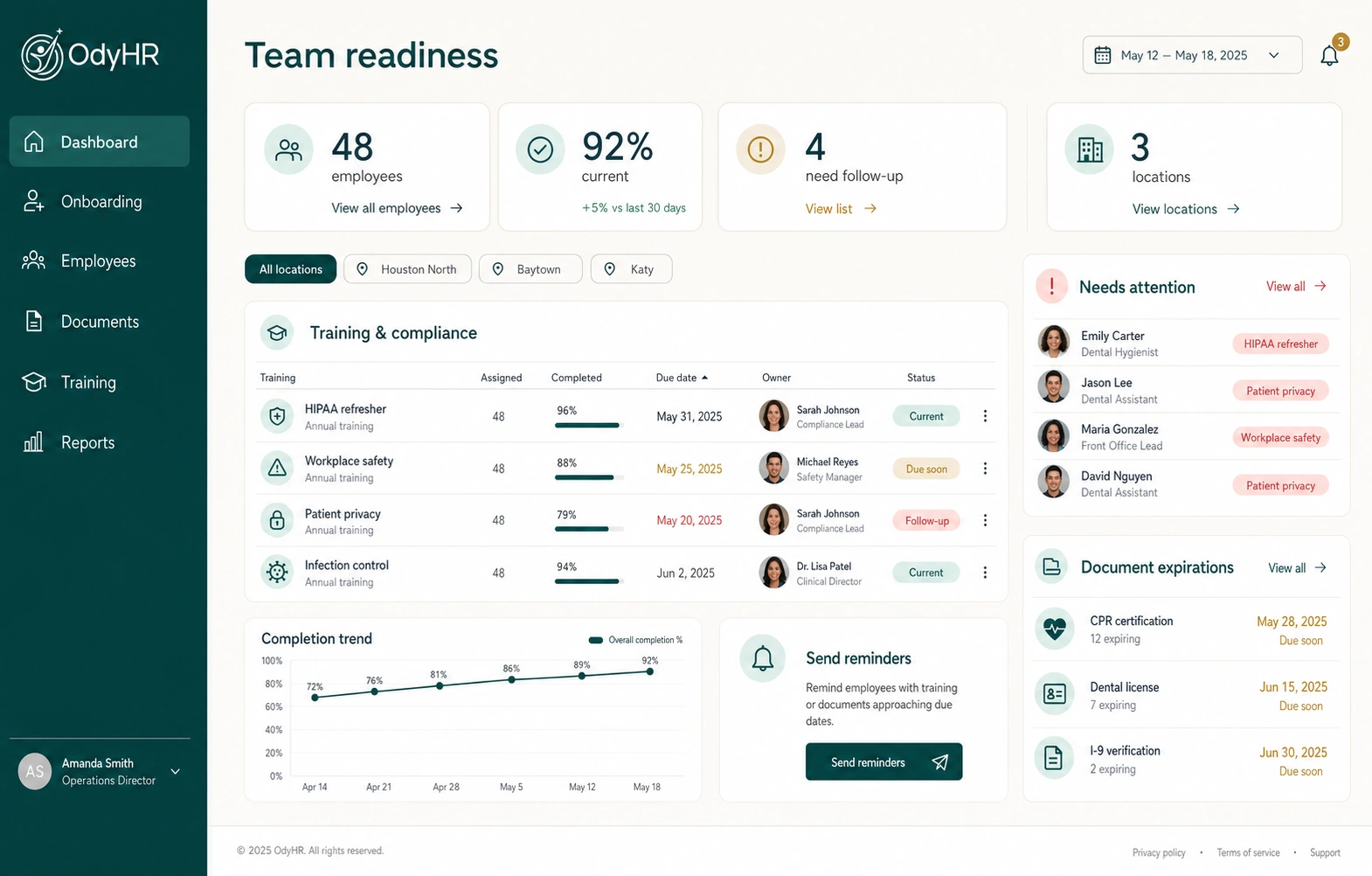
OdyHR keeps training assignments and completion with each employee record, so you can see who completed first aid or CPR training alongside their other documents. Its onboarding checklists can also assign a task, owner and due date, such as showing each new hire where the nearest kit and eyewash station are.
OdyHR does not track supply inventory, send automatic expiration alerts, or confirm OSHA compliance. The stock log, renewal follow-up, kit contents and safety decisions stay with your business and your safety advisor.
Questions
Does OSHA require a specific first aid kit?
No. 29 CFR 1910.151 requires adequate supplies to be readily available but does not list contents. Its non-mandatory appendix points to ANSI Z308.1 as an example, and OSHA has interpreted adequate supplies to include the bleeding control items in an ANSI Class A kit.
How often should a workplace first aid kit be checked?
Construction employers must check kits before each job and at least weekly on each job under 29 CFR 1926.50. For general industry, OSHA says to check periodically and restock as needed, so set a schedule that fits how fast supplies are used.
Is an eyewash station part of the first aid kit requirement?
It is a separate requirement. Where eyes or body may be exposed to injurious corrosive materials, 1910.151(c) requires suitable facilities for quick drenching or flushing within the work area.
Do state OSHA plans have different first aid rules?
They can. State Plans must be at least as effective as federal OSHA and may set their own requirements, so check your state plan if you operate in one.
AUTHORITATIVE REFERENCES
Sources used for this guide
- 29 CFR 1910.151, Medical services and first aidU.S. Department of Labor, OSHA ↗
- Appendix A to 1910.151, First aid kits (Non-Mandatory)U.S. Department of Labor, OSHA ↗
- 29 CFR 1926.50, Medical services and first aid (construction)U.S. Department of Labor, OSHA ↗
- Best Practices Guide: Fundamentals of a Workplace First-Aid Program (OSHA 3317)U.S. Department of Labor, OSHA ↗
- Letter of interpretation: First aid for bleeding control (June 19, 2019)U.S. Department of Labor, OSHA ↗