WORKPLACE SAFETY GUIDE
Workplace Evacuation Drill Debrief Checklist
Turn evacuation-drill observations into assigned corrections, approved procedure updates and clear employee follow-up with a practical debrief checklist.

Important: This guide provides general operational information, not legal advice. Employment requirements vary by location, industry, workforce, and situation. Confirm current requirements with qualified HR or legal professionals.
The drill ends, everyone returns to work, and the coordinator writes down the evacuation time. That number is useful only alongside the details: which instructions were clear, where people became uncertain, and whether the accounting process worked as planned.
A short debrief helps the team turn those observations into specific corrections. OSHA's emergency-action-plan guidance recommends evaluating a drill with management and employees and improving the plan's weaknesses. The checklist below is an editorial way to organize that conversation after a site-approved exercise.
Start with the plan that was tested
Record the location, date, participating shift, exercise scenario and version of the approved plan. Identify who coordinated the exercise and who will review the findings.
Describe the limits too. A drill involving the daytime office team may reveal little about the late shift, a different building or workers who were absent. Keep those gaps visible instead of describing the entire workforce as tested.
Have the safety owner determine which legal requirements apply. OSHA's general-industry emergency-action-plan standard applies when another standard in that part requires a plan; it should not be read as an identical planning or drill-frequency rule for every employer. State-plan, local and industry requirements may also need review.
Ask for observations people can describe
Invite employees and observers to explain what happened from their position. Use questions that separate an observed event from a guessed cause:
- What instruction did you hear or see?
- At what point did you need clarification?
- Did the location names in the instructions match the signs you encountered?
- Was the handoff to the person accounting for your group clear?
- What question remained when the exercise ended?
Write down useful details without turning the meeting into a public discussion of an individual's health or support needs. Route a personal assistance concern privately to the appropriate owner.
For a fictional office example, an observer might report: “Three employees asked whether ‘north assembly area’ meant the visitor lot or the rear courtyard.” That gives the reviewer something concrete to inspect. “Employees ignored the plan” adds a conclusion the observation does not establish.
Review how people were accounted for
Ask the coordinator whether the agreed process produced a clear account of the people involved. Check where information passed between employees, supervisors and the person receiving the final report.
OSHA's emergency-preparedness guidance discusses accounting for workers, planning for off-hour occupants and accommodating people who may need evacuation assistance. Use those areas to question the plan's coverage with the safety lead.
For example, a shared-office debrief might reveal that reception and a department manager both assumed the other person was accounting for a visitor. Record the uncertainty and assign a review of the handoff. Do not invent an improvised rescue or re-entry procedure in the debrief; those decisions belong in the approved emergency arrangements.
Give each finding a next action
A useful correction record can be brief: observation, owner, proposed action, target date and evidence needed to close it. The following is a fictional management example, not a prescribed legal form.
Observation: two different names were used for the same assembly location. Owner: the site's safety coordinator. Action: compare the approved plan, signs and employee instructions; obtain approval for consistent wording. Closure evidence: the revised materials have been checked, and affected staff can identify the intended location in a follow-up review.
Keep facilities, equipment and instruction problems distinct enough to assign them to the right people. Replaying a video will not repair a sign or resolve a missing responsibility. If a finding presents an immediate safety concern, use the site's urgent reporting process instead of waiting for the routine action list.
Review approved changes with affected employees
The safety owner should decide whether the findings require a plan revision, a facilities correction, additional instruction or another exercise. Preserve the earlier drill record and identify the approved changes clearly.
For plans covered by 29 CFR 1910.38, the standard calls for review with covered employees when the plan changes or their responsibilities change, as well as when the plan is developed or they are initially assigned. Confirm how this applies to your workplace with the responsible safety professional.
A custom workplace compliance video can explain the approved change using the site's terminology and staff steps. Pair it with the appropriate walk-through, questions or practice. Use the employee training matrix to organize the affected people and follow-up without treating a viewing record as proof of practical readiness.
Close the action with evidence
At the next review, ask what was checked and what remains unresolved. A file marked “updated” is incomplete if the old instruction is still displayed where employees look for it.
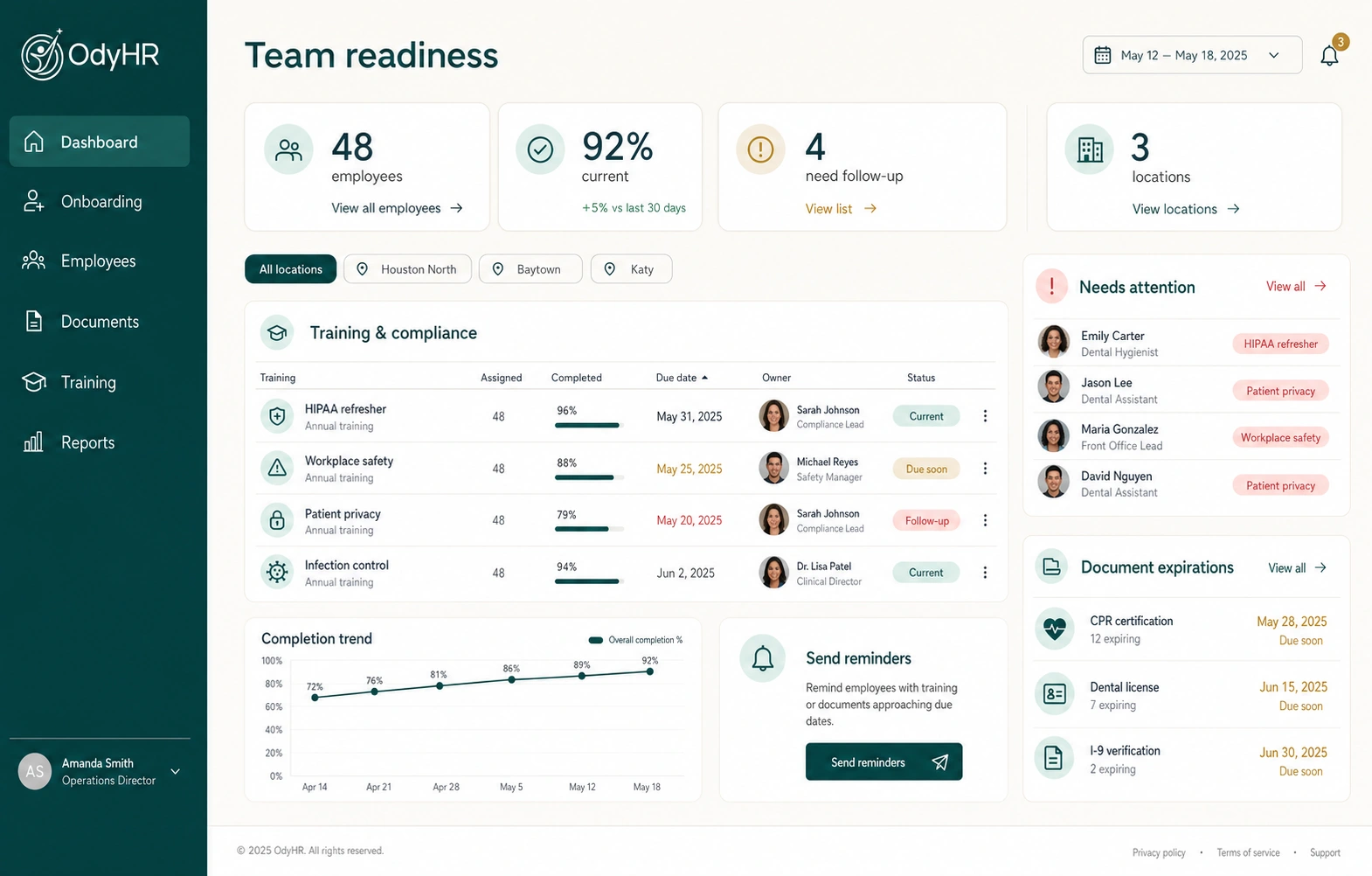
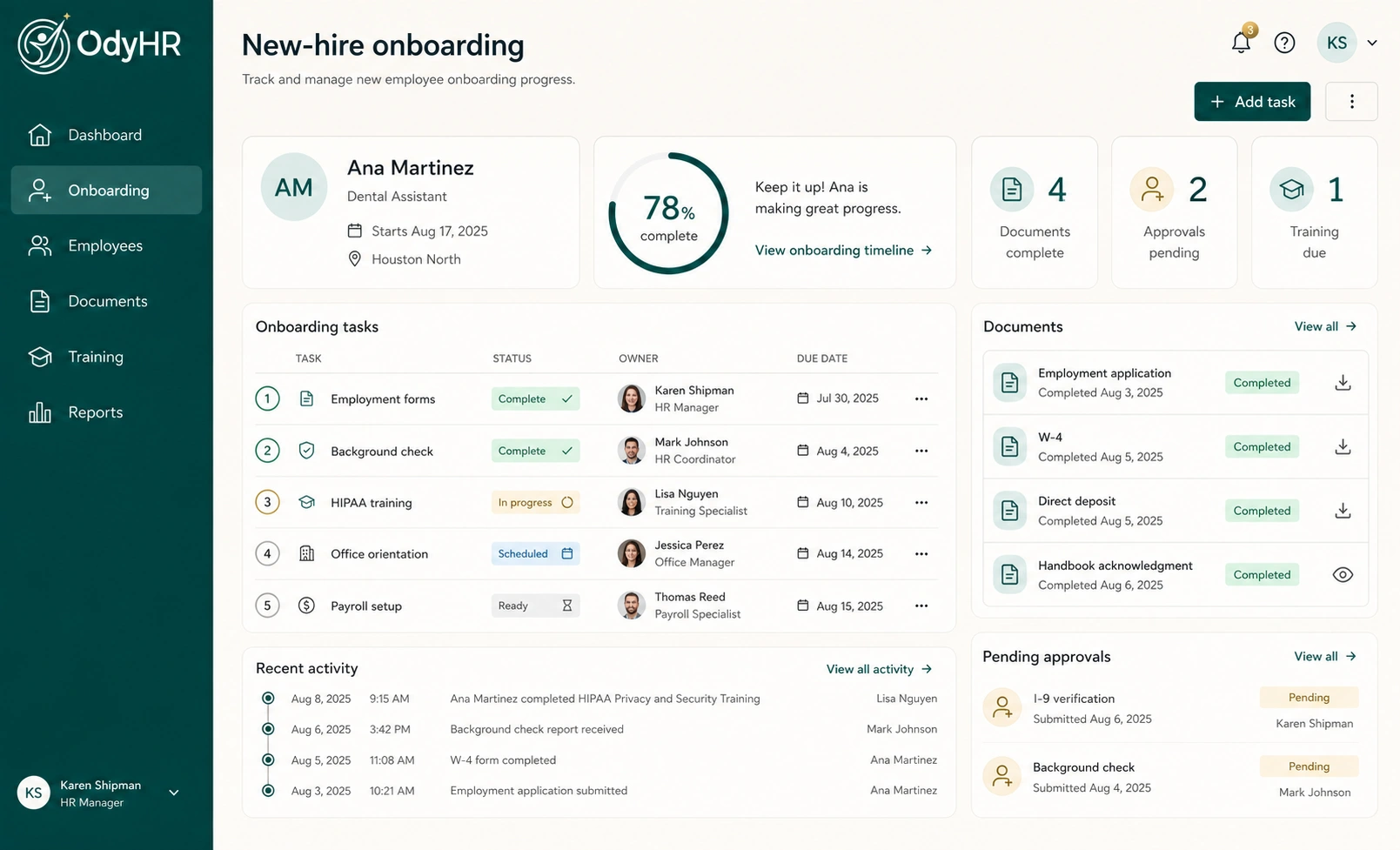
Keep training assignments and completion records connected to the people responsible. OdyHR's product overview describes those records, due dates and follow-up. Discuss your required workflow before choosing a setup.
Talk with OdyHR about custom workplace compliance videos based on your safety team's approved staff steps and completion tracking. Bring a fictional debrief example and the responsibilities you need to organize; the site's safety owner remains responsible for the procedure itself.
AUTHORITATIVE REFERENCES