HIRING GUIDE
Employment Background Check Checklist: What to Do Before Ordering
What a small employer should have in place before ordering a background check: FCRA disclosure and authorization, certification, and the notices that follow.

Important: This guide provides general operational information, not legal advice. Employment requirements vary by location, industry, workforce, and situation. Confirm current requirements with qualified HR or legal professionals.
Before you order an employment background check from a screening company, the federal Fair Credit Reporting Act (FCRA) generally requires you to give the applicant a written disclosure in a document that contains only that disclosure, get the applicant's written authorization, and certify to the screening company that you have done both and will follow the law. You also need a plan for the steps that come after the report: a pre-adverse action notice with a copy of the report and the official Summary of Rights, then an adverse action notice if you decide not to hire.
This checklist walks through those steps in order so the person who places the order knows what must be finished first. It is general information for small businesses, not legal advice. State and local laws can add requirements, so have a qualified employment attorney review your forms and process before you use them.
Decide what you are checking and why
Settle the screening decision before anyone opens a vendor account. Write down:
- The position and work location.
- The type of report you plan to order, such as criminal history, driving record or employment verification, and why it relates to the job.
- The point in hiring when the check happens, for example only after a conditional offer.
- Who is allowed to place the order and who reviews the result.
The FTC and EEOC joint guidance, Background Checks: What Employers Need to Know, tells employers to apply the same standards to everyone applying for the same job, regardless of race, national origin, color, sex, religion, disability, genetic information or age (40 or older). Asking for a check only from some candidates in a role is the kind of uneven treatment that guidance warns against.
Many states, cities and counties also have ban-the-box or fair chance hiring laws that limit when you can ask about criminal history or how you can use it. These rules vary widely and change often, so confirm the ones that apply to each work location before you set the timing.
Finish your interview notes before the report arrives. A completed interview evaluation form shows the job-related reasons for the offer, which keeps the qualification decision separate from the screening review.
Give a standalone disclosure and get written authorization
Under 15 U.S.C. 1681b(b)(2), before you procure a consumer report for employment purposes you must give the applicant a clear and conspicuous written disclosure that a report may be obtained, in a document that consists solely of the disclosure. The applicant must authorize the report in writing. The authorization may appear on the same document as the disclosure.
In practice, that means:
- Do not put the disclosure inside the employment application or offer letter.
- Do not add liability waivers, release language or unrelated acknowledgments to the disclosure.
- If you want the authorization to cover checks during employment, say so clearly and conspicuously, as the FTC describes.
- Review the exact version the applicant will see, including any text your screening company adds.
If the report is an investigative consumer report, one based on personal interviews about character, reputation or lifestyle, the FTC notes there are additional notice obligations. A narrow exception for certain transportation jobs regulated by the Department of Transportation also changes how consent may be given. Ask your screening company and attorney which rules apply to your report type.
Certify to the screening company before the order
Section 1681b(b)(1) lets a screening company furnish an employment report only if the employer certifies that it has met the disclosure and authorization requirements, will follow the adverse action steps if they apply, and will not use the information in violation of equal employment opportunity laws. The FTC's guidance on using consumer reports describes the same certification.
Treat that certification as a gate. The person placing the order should confirm, before clicking submit, that:
- The signed disclosure and authorization are on file for this applicant.
- The report type matches the approved package for the role.
- The order is going through the approved screening company account.
A signed offer letter or completed application is not proof that the disclosure and authorization were handled correctly. If anything is missing, pause the order.
Plan the pre-adverse action notice
If you might reject an applicant based in whole or in part on the report, the FCRA requires you to act before the decision is final. Under section 1681b(b)(3), you must first give the applicant:
- A copy of the report you relied on.
- A written description of their rights. The FTC points employers to A Summary of Your Rights Under the Fair Credit Reporting Act. The current model form is posted on the CFPB's FCRA model forms page; your screening company may also supply it.
The FTC explains that this advance notice gives the person a chance to review the report and tell you if it is inaccurate or incomplete. Federal guidance does not set a specific number of days to wait, so decide with your attorney how long you will allow for a response, and note that some state or local laws do set timing. Decide in advance who sends the notice and who reads any reply.
Review criminal history individually
The EEOC's 2012 enforcement guidance on arrest and conviction records under Title VII says an arrest alone does not establish that criminal conduct occurred. It describes looking at the nature and gravity of the offense, the time that has passed, and the nature of the job. It also describes an individualized assessment: telling the person they may be excluded because of their record, giving them a chance to show why the exclusion should not apply to them, and considering what they provide.
Two cautions. First, Title VII generally covers employers with 15 or more employees, but state laws often reach smaller employers. Second, as of October 2026 the EEOC has sent a draft rule to rescind this 2012 guidance for White House review. The guidance is still posted on eeoc.gov, but check its current status. Rescinding guidance does not change Title VII itself or state and local fair chance laws, and many fair chance laws require their own individualized review and notices.
Send the adverse action notice after the decision
If you decide not to hire based on the report, the FTC says you must then notify the applicant orally, in writing or electronically. The notice tells the applicant:
- That they were rejected because of information in the report.
- The name, address and phone number of the screening company.
- That the screening company did not make the decision and cannot explain the specific reasons.
- That they have the right to dispute the accuracy or completeness of the report and to request an additional free report from the company within 60 days.
Do not let an automated vendor status, such as a flag or a "needs review" label, trigger a rejection message. The decision owner should confirm that the pre-adverse action step was completed and that the decision is final before anything goes out.
Keep reports private and track the hiring steps
Limit who sees the full report. A hiring manager may only need to know that review is pending. When you no longer need a report, the FTC says to dispose of it securely: shred or burn paper, and delete electronic files so they cannot be read or reconstructed. Ask your attorney how long to keep hiring records under federal, state and local rules before disposal.
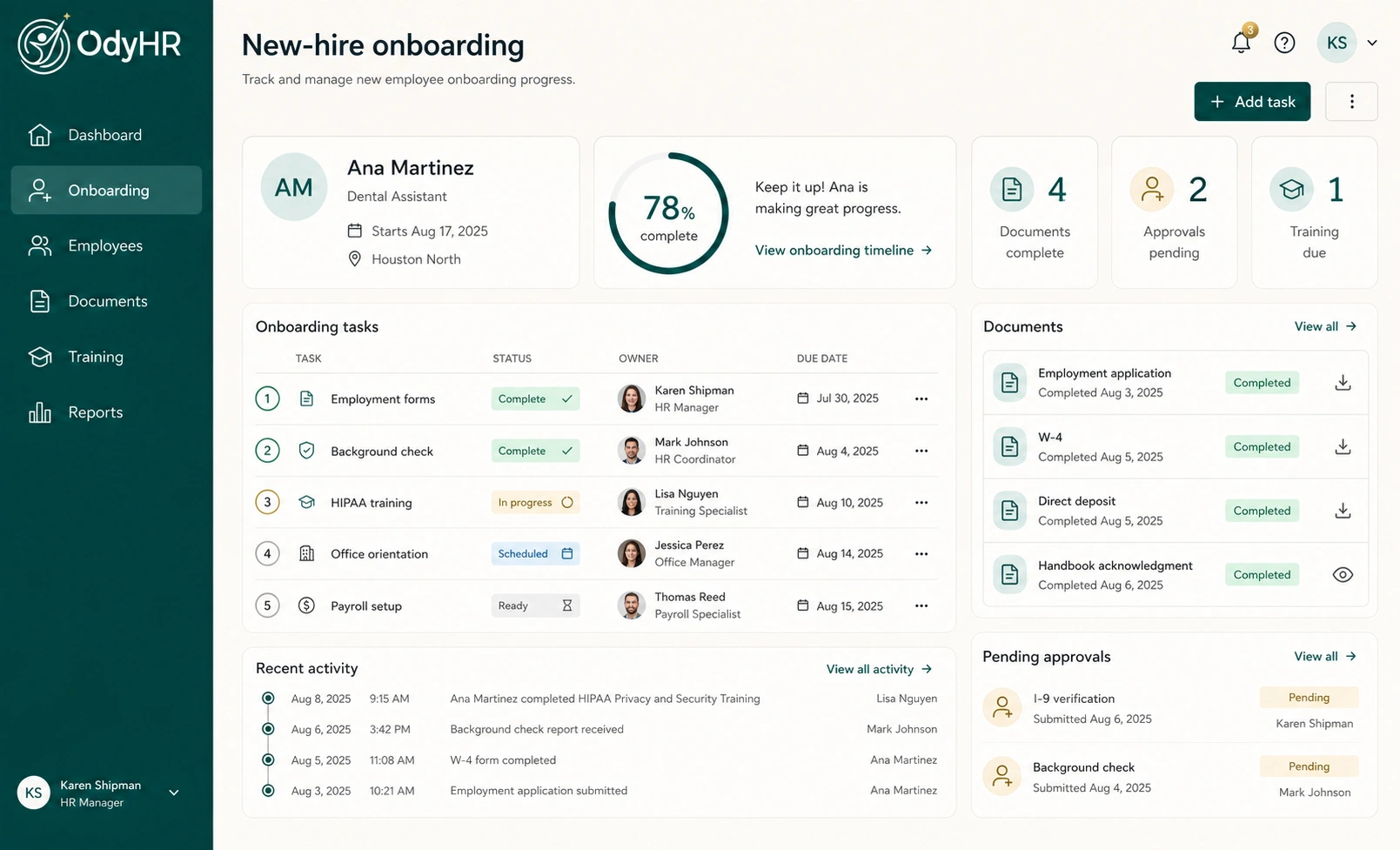
OdyHR keeps the rest of the hiring process together: careers-page listings, applications and resumes, candidate review, interviews, offers and the handoff into onboarding. OdyHR does not order background checks, connect to screening companies, send FCRA notices or confirm legal compliance. Those steps stay with you, your screening company and your attorney.
Questions
Can the background check disclosure be part of the job application?
No. The FCRA requires the disclosure to be in a document that consists solely of the disclosure, and the FTC says it cannot be in an employment application. The applicant's written authorization may appear on the same standalone document.
How long do I have to wait after a pre-adverse action notice?
Federal FTC guidance does not set a specific number of days. The notice must come before the final decision so the person can review the report, and some state or local laws set their own timing, so confirm with your attorney.
Where do I get the Summary of Rights form?
The CFPB posts A Summary of Your Rights Under the Fair Credit Reporting Act on its FCRA model forms page, in English and Spanish. Screening companies often provide it too, but check that you are using the current version.
Does the FCRA apply if I search public records myself?
The FCRA steps in this checklist apply when you get a report from a company that compiles background information. Antidiscrimination laws and state or local fair chance laws can still apply to checks you do yourself.
AUTHORITATIVE REFERENCES
Sources used for this guide
- Background Checks: What Employers Need to KnowFederal Trade Commission and U.S. Equal Employment Opportunity Commission ↗
- 15 U.S.C. 1681b, Permissible purposes of consumer reportsU.S. Code (via Cornell Legal Information Institute) ↗
- Using Consumer Reports: What Employers Need to KnowFederal Trade Commission ↗
- FCRA Model Forms and Disclosures (Summary of Consumer Rights)Consumer Financial Protection Bureau ↗
- Enforcement Guidance on the Consideration of Arrest and Conviction Records in Employment DecisionsU.S. Equal Employment Opportunity Commission ↗