CONSTRUCTION HR GUIDE
Construction Employee Training Records for the Next Jobsite
Connect construction training records to the next jobsite and task. Separate OSHA Outreach cards, site briefings and required task-specific instruction.
Important: This guide provides general operational information, not legal advice. Employment requirements vary by location, industry, workforce, and situation. Confirm current requirements with qualified HR or legal professionals.
Before a crew moves to another jobsite, someone needs to connect each employee's training history with the work planned there. A folder full of cards and certificates gives that review a starting point. The supervisor still needs to know which instructions apply to this site, this equipment and this assignment.
Construction employee training records are most useful when they support that conversation before work begins. Keep the existing evidence, identify what has changed and give unresolved questions to the person qualified to answer them. This guide describes an administrative process; your safety lead must determine the requirements for the actual work.
Start with the assignment on the work schedule
Use the planned work to frame the review. Record the employee's role, destination site and expected tasks. Ask the site or safety owner which requirements apply and where the current instructions are kept. A familiar job title can involve different hazards when the location, equipment or sequence changes.
OSHA's construction safety-training standard requires employers to instruct employees about unsafe conditions and the regulations applicable to their work environment. That makes the intended assignment an important starting point for the training conversation.
For example, “joining the installation crew” leaves more open than a task description that identifies the work area and equipment involved. HR can collect the record references while the safety owner decides what instruction and supervision the assignment needs. Give each unresolved item an owner before it disappears into the general onboarding list.
Label OSHA Outreach cards accurately
OSHA's Outreach Training Program offers 10-hour and 30-hour construction classes and issues course-completion cards. OSHA describes the program as voluntary at the federal level, although some jurisdictions, employers or others require it. Outreach courses are not certifications and do not satisfy the training requirements of specific OSHA standards.
Use a precise record label such as “OSHA 10-hour Construction Outreach course-completion card.” Avoid a broad status such as “OSHA certified,” which gives the next supervisor an inaccurate impression of what the document establishes.
OSHA's Outreach FAQ also says construction student course-completion cards have no expiration date. A separate employer or site requirement may call for more recent training. Record the source of that requirement separately, rather than adding an invented expiry date to the card. Check the actual destination's requirements before arranging another course.
Make the site briefing easy to identify
Keep the site introduction recognizable in the employee's history. A briefing record can identify the site, date, presenter and version of the local instructions discussed. The responsible site owner should choose the subjects, such as reporting routes, access arrangements and emergency procedures, for that location.
Explain how employees can raise a question after the briefing. Someone may understand a general instruction but be unsure which supervisor to contact during a particular shift. That is worth resolving while the crew is preparing to start.
A company introduction video can help explain routine processes, but the safety owner still needs to decide the instruction, practical work and checks appropriate to each assignment. Keep those decisions visible instead of treating a single viewing record as the whole training history.
Preserve the evidence required for the specific task
Some OSHA standards prescribe particular training records. For construction fall protection, 29 CFR 1926.503 requires training for employees who might be exposed to fall hazards. Its written certification record includes the employee's identity, training dates and the trainer's or employer's signature. The latest training certification must be maintained.
The same standard also addresses retraining when workplace or equipment changes make previous training obsolete, or when an employee's understanding or skills are inadequate. A scheduled expiry date alone would miss those triggers.
Have the safety owner specify the evidence appropriate to each applicable standard. An attendance list, a site briefing and a task-specific training record may serve different purposes. Administrative staff should preserve their original descriptions so the person reviewing the file can tell what happened and which requirement it addresses.
Work through a fictional crew transfer
Imagine Maya is moving from one commercial project to another. Her employee record contains an OSHA 30-hour Construction Outreach card and prior fall-protection training documentation. The destination project uses a different fall-protection system.
The coordinator retrieves the existing records and notes the planned assignment. The safety lead reviews the changed equipment and determines what retraining is needed under the applicable requirements. The new site's briefing is recorded separately. Maya's supervisor confirms the required steps before assigning the affected work.
The handoff note might read: “Existing records located. Destination equipment review assigned to safety lead. Site briefing scheduled. Affected task assignment pending safety review and required training.” Each entry describes an actual step without discarding Maya's previous learning or assuming it covers the changed conditions.
Once the responsible people finish the review and training, they update the relevant records. Any work restriction or assignment decision follows the company's approved safety process.
Give the next supervisor a usable handoff
The next supervisor should be able to locate the applicable records, see any open action and identify who made the training decision. Keep unnecessary personal details out of a broadly shared crew list. Use the employee training matrix for assignment coordination, with references to evidence in its approved location.
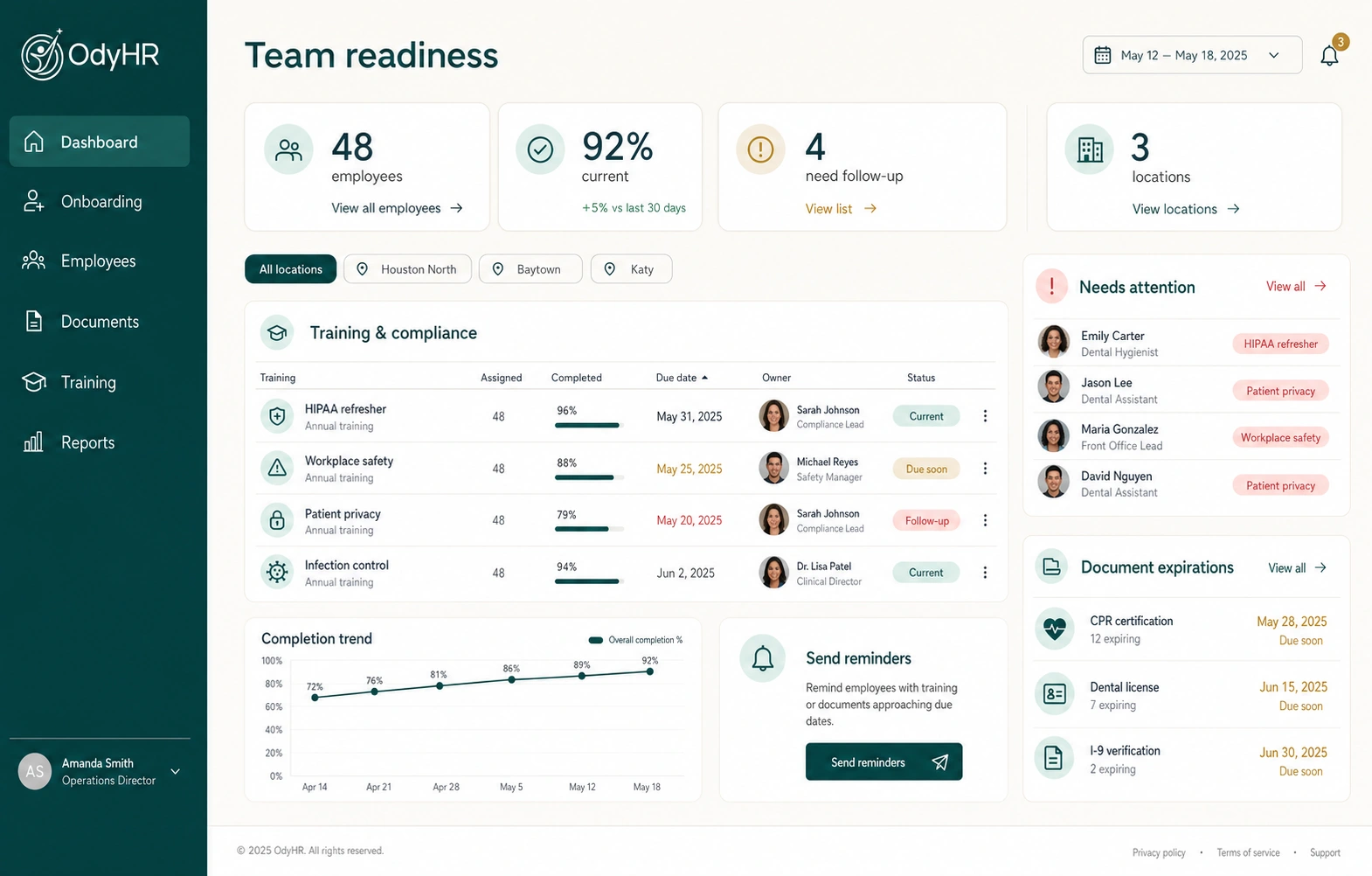
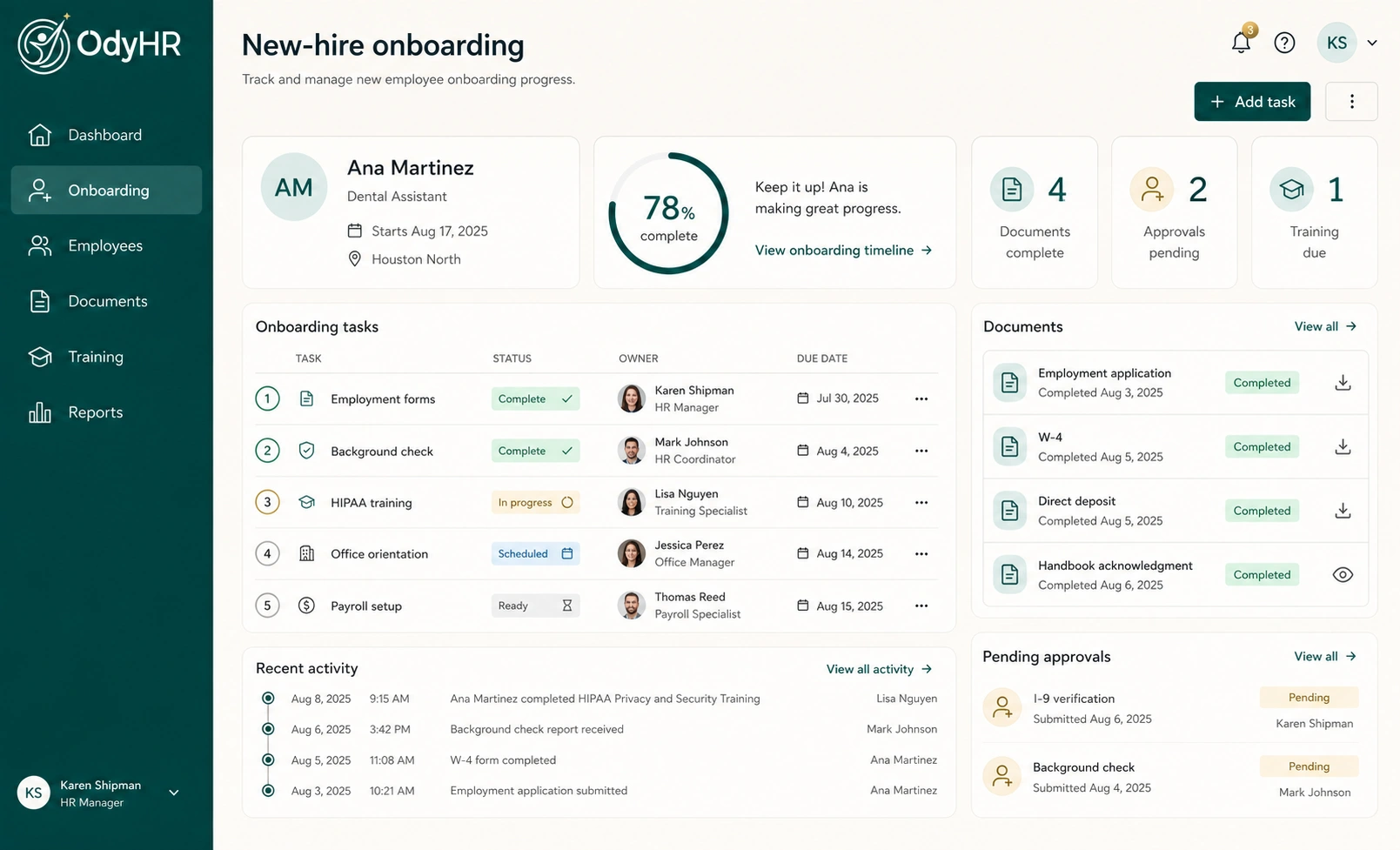
OdyHR can hold private, employee-scoped copies of existing certificates and licenses as part of the employee document record. The responsible people still determine whether the evidence meets the needs of the work.
Talk through your construction workflow with OdyHR. Bring a fictional crew move, the records involved and the people responsible for review so the conversation starts with the handoff your business needs to manage.
AUTHORITATIVE REFERENCES