PAY AND POLICY GUIDE
Required Training Outside Work Hours: Do You Have to Pay? A Checklist
Required training is generally paid time for covered nonexempt employees, even after hours or at home. Use this checklist to review the federal test, travel time and the workweek total before you assign it.

Important: This guide provides general operational information, not legal advice. Employment requirements vary by location, industry, workforce, and situation. Confirm current requirements with qualified HR or legal professionals.
Yes, in most cases. Under the federal Fair Labor Standards Act (FLSA), training an employer requires is generally paid work time for covered nonexempt employees, even when it happens before or after a shift or at home. Federal rules let training time go unpaid only when all four conditions are met: it is outside regular working hours, it is truly voluntary, it is not directly related to the employee's current job, and the employee does no productive work during it. A mandatory course fails the voluntary test by itself.
This checklist covers what to review before sending a course with a "finish it at home" deadline. It is general information, not legal advice. State law can add requirements, so confirm the rules where your employees work with a qualified HR, payroll or employment-law adviser.
Confirm who the federal rules cover
According to the Department of Labor (DOL), enterprise coverage generally applies to businesses with an annual dollar volume of sales or business done of at least $500,000. Hospitals, businesses providing residential medical or nursing care, schools, preschools and government agencies are covered regardless of volume. Employees of smaller businesses can still be individually covered when their work regularly involves interstate commerce.
- Nonexempt employees: the training-time and overtime rules in this checklist apply to them.
- Exempt employees: FLSA overtime does not apply to properly classified exempt employees. Do not assume a salary alone makes someone exempt.
- State and local law: some states have their own hours-worked, overtime or training-time rules.
Run the four-part test before you assign the course
Under 29 CFR 785.27, attendance at lectures, meetings and training programs need not be counted as working time only if every one of these is true.
- Outside regular working hours. Moving a course to the evening satisfies only this one condition.
- Voluntary in fact. Attendance is not voluntary if the employer requires it, or if the employee is led to believe that skipping it would hurt their working conditions or continued employment (29 CFR 785.28). Calling a course "optional" does not help if managers treat it as expected.
- Not directly related to the job. Training is directly related if it is designed to help the employee do their current job more effectively (29 CFR 785.29). Training for another job, or a new or additional skill, may not be. A bona fide course to prepare for advancement to a higher skill is not treated as directly related, even if it incidentally helps in the current role.
- No productive work. If the employee answers customer messages, finishes reports or covers tasks during the session, that time is work.
If any one condition fails, plan to pay for the time.
Know the narrow exceptions before relying on one
A few situations are not hours worked. They are narrow, so review the facts with an adviser first.
- Independent school on the employee's own initiative. If an employee chooses to attend an independent school, college or trade school after hours, that time is not hours worked for the employer, even if the course relates to the job (29 CFR 785.30).
- Employer program that matches outside courses. An employer may offer instruction that corresponds to courses at independent bona fide institutions. Voluntary attendance outside working hours is not hours worked, even if the course is job related or the employer pays for it (29 CFR 785.31).
- Apprenticeship instruction. Related supplemental instruction under a qualifying written apprenticeship agreement may be excluded if it involves no productive work, unless the agreement says the time is hours worked (29 CFR 785.32).
- Certification required by law. The special federal rule for after-hours training required by law for certification is in 29 CFR 553.226 and applies to state and local government employees. A private employer that requires or schedules a certification course should not assume that rule applies to its staff.
Count travel to and from the training
When training is held away from the usual workplace, the travel may also be work time, depending on the trip.
- Normal commute: ordinary travel from home to work is not work time (29 CFR 785.35).
- During the workday: travel from the job site to a training site as part of the day's work counts as hours worked (29 CFR 785.38).
- One-day training in another city: the travel generally counts, but the employer may deduct the employee's normal home-to-work commute and usual meal time (29 CFR 785.37).
- Overnight trips: travel that cuts across the employee's normal working hours is work time, including the same hours on nonworking days. As an enforcement policy, DOL does not count time spent as a passenger outside regular working hours (29 CFR 785.39).
- Work while traveling: required work done while traveling counts (29 CFR 785.41).
Write an assignment notice that matches payroll
DOL's hours-worked guidance explains that work an employer did not request, but suffered or permitted, is still work time that must be paid. A manager should never tell employees to complete required training and leave it off their timesheets. Make sure the notice answers these questions:
- What course or session must the employee complete, and by when?
- When is time available to do it, ideally a scheduled block during a shift?
- How should the employee record the time, using the normal timekeeping process?
- Who handles access problems or a course that takes longer than expected?
- Who can move the deadline if the workload makes it unrealistic?
Review the notice with whoever runs payroll before it goes out.
Record the actual time and check the workweek total
Federal recordkeeping rules require covered employers to keep the hours worked each workday and total hours worked each workweek for nonexempt employees (29 CFR 516.2). Record the time the training actually took. A course advertised as 30 minutes may take one employee 50, and a completion certificate shows that learning happened, not how long it took.
Then check the week as a whole. Covered nonexempt employees must receive overtime for hours worked over 40 in a workweek, and DOL treats the workweek as a fixed, recurring 168-hour period that cannot be averaged across weeks. A rule that overtime must be approved in advance does not remove the right to pay for overtime actually worked.
Fictional example: an employee works 39 hours on shift and spends 2 hours on a required course at home in the same workweek. The total to review is 41 hours, so one hour is overtime. Payroll should confirm the regular rate and any state rules that apply.
Before payroll closes, compare the list of assigned training with submitted time. Keep the completion evidence in an employee training record and the hours in your timekeeping system, with a named owner for each. An employee training matrix shows which assignments fall in each pay period.
Keep training records and pay records connected
Each cycle, confirm the learning record shows what was completed, confirm payroll received the hours, and give employees a clear way to raise an omission. If a correction is needed, keep the original entry and follow your normal correction process.
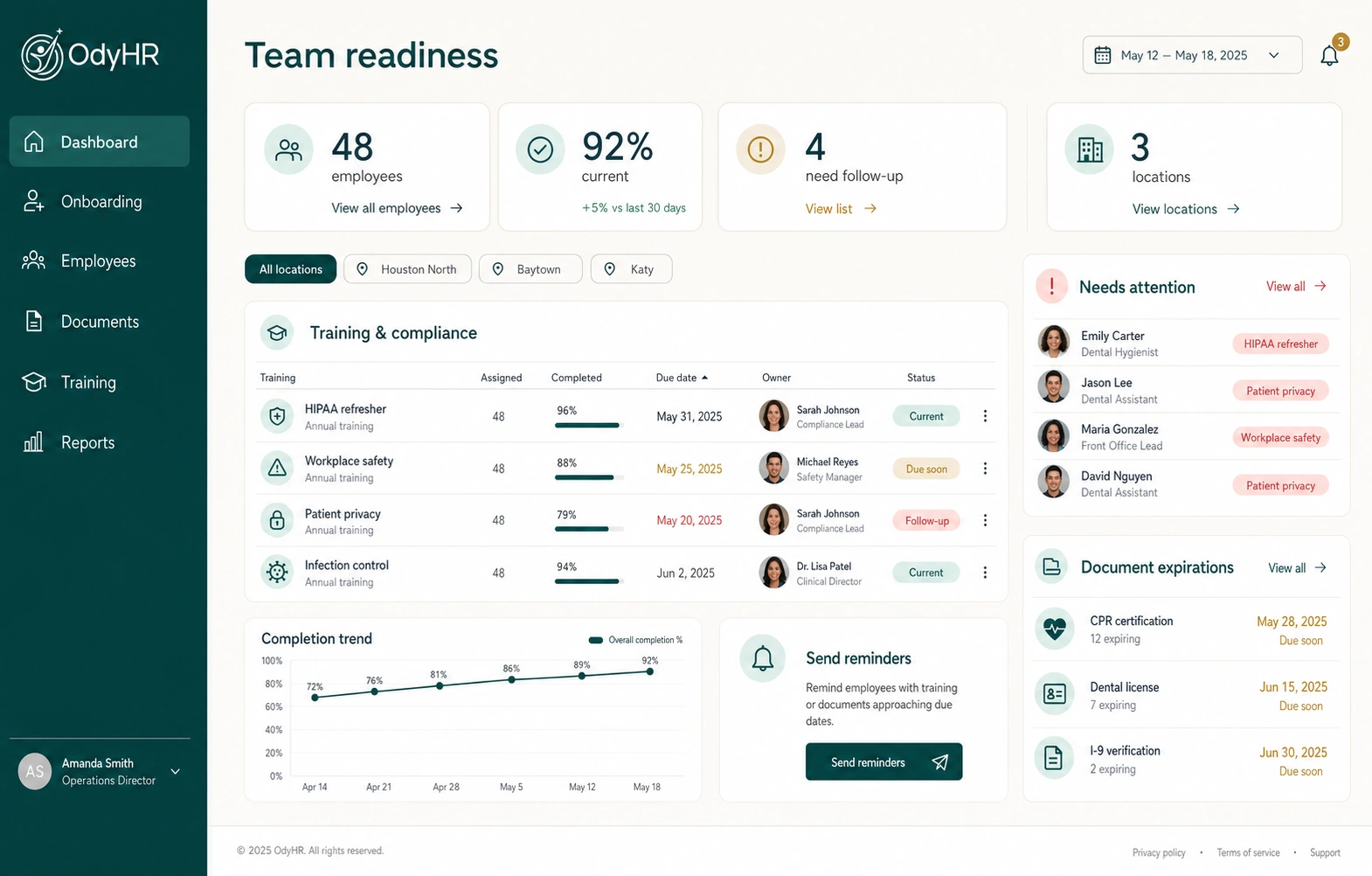
OdyHR keeps training assignments and completion with each employee record, so you can see who was assigned what and when they finished. OdyHR does not track time, run payroll or decide whether training is compensable. Recording hours, paying them and getting advice on the rules stay with the employer, its payroll process and its advisers.
Questions
Do I have to pay employees for mandatory training outside work hours?
Under the FLSA, generally yes for covered nonexempt employees. Required training fails the voluntary condition, and federal rules exclude training time only when it is outside regular hours, voluntary, not directly related to the job and involves no productive work. State law may add requirements.
Is online training done at home paid time?
Location does not change the analysis. If the course is required or job related, time a nonexempt employee spends on it at home is generally hours worked and should be recorded through your normal timekeeping process.
Do I have to pay for travel time to a training session?
It depends on the trip. A normal commute is not work time, but travel during the workday, a one-day trip to another city (minus the normal commute and meal time) and overnight travel during normal working hours generally count under 29 CFR 785.35 to 785.39.
What if an employee takes a college course on their own?
If an employee chooses on their own to attend an independent school, college or trade school after hours, the time is not hours worked for the employer, even if the course relates to the job (29 CFR 785.30).
Does a state certification requirement make training unpaid?
Not automatically. The federal rule for after-hours training required by law for certification (29 CFR 553.226) applies to state and local government employees. Private employers should review required certification training with an adviser.
AUTHORITATIVE REFERENCES
Sources used for this guide
- 29 CFR Part 785, Hours Worked (training time 785.27 to 785.32, travel time 785.33 to 785.41)Electronic Code of Federal Regulations ↗
- Fact Sheet #22: Hours Worked Under the FLSAU.S. Department of Labor, Wage and Hour Division ↗
- Fact Sheet #23: Overtime Pay Requirements of the FLSAU.S. Department of Labor, Wage and Hour Division ↗
- Fact Sheet #14: Coverage Under the FLSAU.S. Department of Labor, Wage and Hour Division ↗
- 29 CFR 516.2, Records for employees subject to minimum wage and overtimeElectronic Code of Federal Regulations ↗