LEAVE GUIDE
FMLA Leave Request Intake Checklist for Managers: What to Do First
Employees rarely say "FMLA." Here is how managers can spot a possible FMLA request, respond without promising anything, and route it before the five-business-day clock runs.

Important: This guide provides general operational information, not legal advice. Employment requirements vary by location, industry, workforce, and situation. Confirm current requirements with qualified HR or legal professionals.
When an employee mentions surgery, a pregnancy, a hospital stay or caring for a seriously ill parent, a manager's job is to recognize that the request may be FMLA leave, record a few basic facts, and hand it to the person who handles leave the same day. The manager should not decide eligibility, ask for a diagnosis, or approve or deny the leave on the spot.
Speed matters because the Family and Medical Leave Act (FMLA) puts short deadlines on employers once they learn that leave may qualify. This checklist covers the first conversation and the handoff. It is general information for employers covered by the federal FMLA, not legal advice, and state law or your own policy may add steps.
Recognize a possible FMLA request
Employees do not have to say "FMLA." Under 29 CFR 825.303(b), an employee asking for leave for a qualifying reason for the first time need not mention the law at all. They only need to give enough information for the employer to see that the FMLA may apply.
Treat these as signals to route the request:
- The employee is pregnant, or was or will be hospitalized overnight.
- A condition keeps the employee from doing the job.
- The employee or a spouse, child or parent is under continuing care from a health care provider.
- A new child is arriving through birth, adoption or foster care.
- A family member's military deployment or a service member's serious injury or illness is involved.
Simply calling in "sick" with no other detail is not enough notice on its own. If you are unsure, route it anyway and let the leave administrator ask follow-up questions.
Fictional example: A shift lead tells her manager she needs "a few weeks off next month to help my dad after his heart surgery." She never mentions FMLA. That is a possible FMLA request and should be routed that day.
What to say, and what not to say, in the first conversation
Keep the first conversation short, kind and neutral. A script that works for most managers:
"Thanks for telling me. I'm going to pass this to [name], who handles leave requests, so you get accurate information about next steps. Is there a private way you'd like them to reach you?"
During that conversation, managers should not:
- Ask for a diagnosis or medical history. The leave administrator decides what certification, if any, to request.
- Promise that leave is approved, paid or job protected.
- Say the employee is not eligible, even if they are new.
- Require the word "FMLA" or a form before passing the request along.
- Call the employee's doctor. The regulations say the employee's direct supervisor may never contact the employee's health care provider (29 CFR 825.307(a)).
Capture the intake facts and route the same day
The employer's notice deadlines run from when the employer learns that leave may qualify, and a supervisor hearing about it may be enough to start that clock. Set an internal rule to hand off the same business day. Record only what the leave administrator needs:
- Date and time the employee first raised the need, and how (in person, phone, text, email).
- Who received it.
- Expected start date and duration, marked "unknown" if the employee does not know yet.
- Whether the leave looks continuous, intermittent or a reduced schedule.
- Whether the employee followed your usual call-in or request procedure, without treating a missing step as a denial.
- The employee's preferred private contact method.
- Name of the leave administrator the request went to, and when.
Name a backup leave contact for when the primary person is out. Do not write the medical reason on schedules, team chats or shared task lists. "Approved absence, dates pending" is enough for staffing.
Coverage and eligibility are the administrator's call
Managers do not need to work out eligibility, but knowing the basic rules helps you avoid saying something wrong. According to DOL Fact Sheet #28 and 29 CFR 825.104 and 825.110:
- Covered employers: private employers with 50 or more employees in 20 or more workweeks in the current or preceding calendar year, plus public agencies and public and private elementary and secondary schools regardless of size.
- Eligible employees: at least 12 months with the employer, at least 1,250 hours of service in the 12 months before leave starts, and work at a location where the employer has at least 50 employees within 75 miles.
- Leave amount: up to 12 workweeks in a 12-month period for most reasons, or up to 26 workweeks for military caregiver leave.
Even when the federal FMLA does not apply, other rules may. State or local family and medical leave laws can give greater rights, and the FMLA does not override them (29 CFR 825.701). The Americans with Disabilities Act and other anti-discrimination laws are separate obligations that can apply to the same situation (29 CFR 825.702). That is one more reason the decision belongs with a trained administrator or legal advisor, not the first manager who hears about it.
The notice and certification timeline your leave administrator tracks
Managers do not send these notices, but knowing the clock explains why a same-day handoff matters. Under 29 CFR 825.300 and 825.305:
- Eligibility notice: within five business days after the employee requests leave or the employer learns the leave may qualify, absent extenuating circumstances. It may be oral or written.
- Rights and responsibilities notice: written, and given each time an eligibility notice is given. DOL's optional Form WH-381 combines both.
- Medical certification, if required: the employer generally requests it when notice is given or within five business days. The employee then has at least 15 calendar days to return it, unless that is not practicable despite diligent, good faith efforts. If a certification is incomplete or insufficient, the employer must say in writing what is missing and generally allow seven calendar days to fix it.
- Designation notice: within five business days after the employer has enough information to decide whether the leave is FMLA leave, absent extenuating circumstances. DOL's optional form is WH-382.
DOL's optional certification forms are WH-380-E (employee's own serious health condition), WH-380-F (family member's serious health condition), WH-384 (qualifying exigency), and WH-385 and WH-385-V (military caregiver leave). Employers may use their own forms if they ask only for the same basic information.
Keep medical details out of everyday employee files
Under 29 CFR 825.500(g), FMLA certifications and medical histories of employees or their family members must be kept as confidential medical records, in files separate from the usual personnel file. If the ADA or GINA also applies, their confidentiality rules apply too. Supervisors may be told about necessary work restrictions and accommodations, not the diagnosis.
In practice, the manager's intake note goes to the leave administrator, and any medical paperwork goes straight into the restricted location they control. Our guide on organizing employee files with a separate restricted category for medical records shows how to set up that separation and decide who can access it.
Once leave dates are set, plan work coverage separately using an employee handover plan for planned leave, sharing availability dates rather than the reason for leave.
Where OdyHR fits, and what stays with you
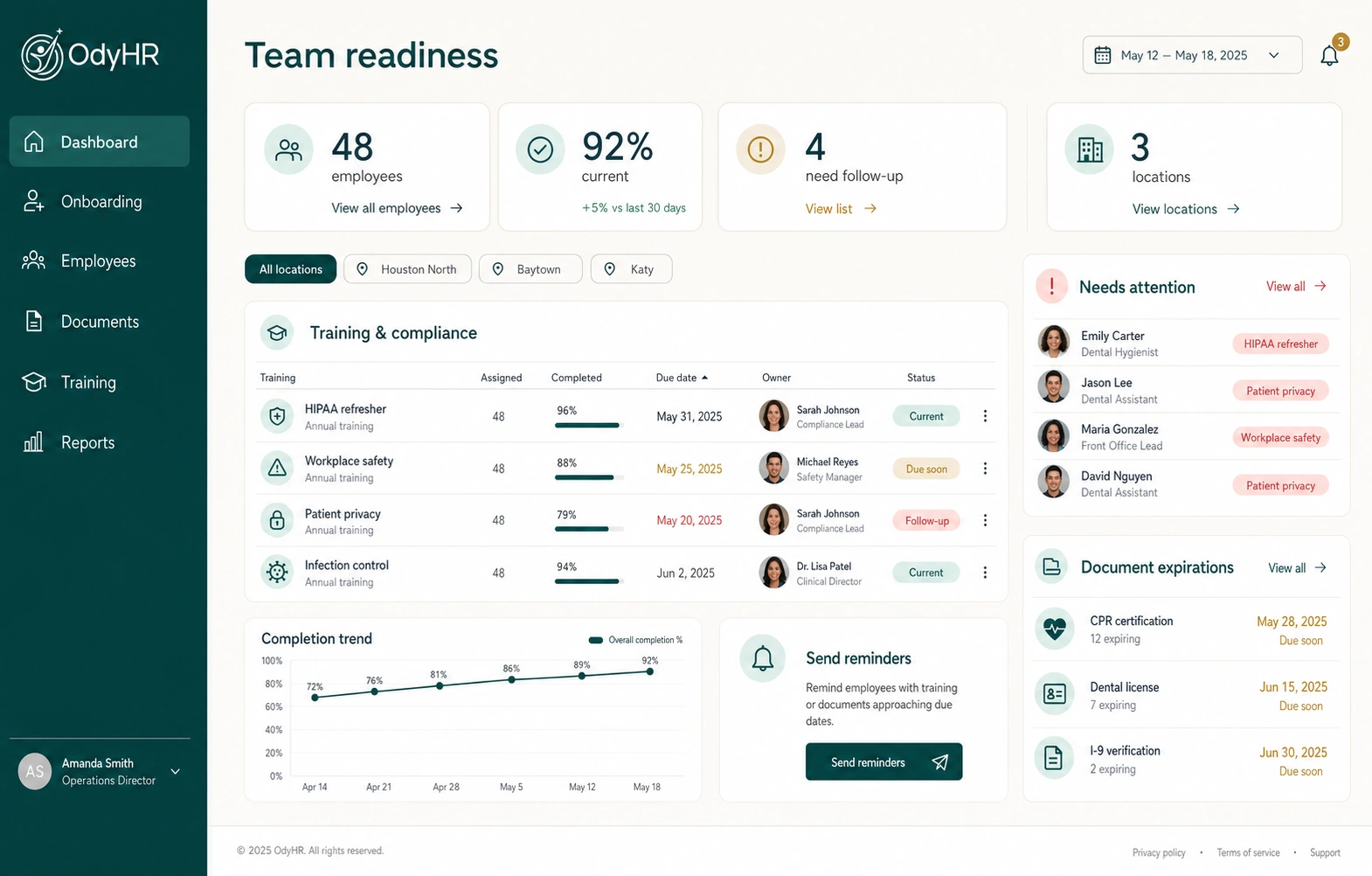
OdyHR keeps employee details, documents, role history, training, evaluations and approvals together in one employee record, which can make it easier to find the right person and paperwork when coverage is needed. It does not administer leave or FMLA, determine eligibility, send or track legal notices, or guarantee compliance.
Leave decisions, notice deadlines and confidential medical files stay with your leave administrator, the systems your company has approved for them, and your legal advisors.
Questions
Does an employee have to say "FMLA" to request FMLA leave?
No. When an employee first asks for leave for a qualifying reason, they do not have to mention the FMLA. They need to give enough information for the employer to see that the leave may qualify (29 CFR 825.303(b)).
How fast must an employer respond to a possible FMLA request?
A covered employer must give the eligibility notice, along with a written rights and responsibilities notice, within five business days of the request or of learning the leave may qualify, absent extenuating circumstances (29 CFR 825.300). That is why managers should route requests the same day.
Can a manager ask an employee for their diagnosis?
Managers should not ask. The leave administrator decides whether to request a medical certification, and the regulations bar the employee's direct supervisor from contacting the employee's health care provider.
How long does an employee have to return a medical certification?
At least 15 calendar days after the employer's request, unless that is not practicable despite the employee's diligent, good faith efforts (29 CFR 825.305(b)).
Where should FMLA medical paperwork be stored?
In confidential files kept separate from the usual personnel file (29 CFR 825.500(g)). Access should be limited to the people your leave administrator approves.
AUTHORITATIVE REFERENCES
Sources used for this guide
- Fact Sheet #28: The Family and Medical Leave ActU.S. Department of Labor, Wage and Hour Division ↗
- Fact Sheet #28D: Employer Notification Requirements under the FMLAU.S. Department of Labor, Wage and Hour Division ↗
- Fact Sheet #28E: Employee Notice Requirements under the FMLAU.S. Department of Labor, Wage and Hour Division ↗
- FMLA forms (WH-380-E, WH-380-F, WH-381, WH-382, WH-384, WH-385, WH-385-V)U.S. Department of Labor, Wage and Hour Division ↗
- 29 CFR Part 825: The Family and Medical Leave Act of 1993Electronic Code of Federal Regulations ↗