HR OPERATIONS GUIDE
Workplace Accommodation Requests Before Day One: A Manager Handoff Checklist
Coordinate a workplace accommodation request before a new hire starts, with clear HR ownership, confidential records and checks on agreed setup work.

Important: This guide provides general operational information, not legal advice. Employment requirements vary by location, industry, workforce, and situation. Confirm current requirements with qualified HR or legal professionals.
A new hire asks whether the company can arrange equipment they need to do their job. The hiring manager says yes. The start date approaches, but nobody has confirmed who will order the equipment, check it or speak with the employee if it is delayed.
That gap deserves attention before the welcome meeting. An accommodation request needs a responsible reviewer and a clear route from the conversation to the agreed work.
On September 28, 2026, the EEOC announced a lawsuit against Majestic Developers, a Sugar Land, Texas, real estate developer. The agency alleges that an engineering applicant was assured during hiring that requested computer equipment would be provided, then was dismissed on his first day after raising accommodation needs. The release describes hiring events beginning in late 2024. These are allegations in a lawsuit, not a final court finding. Read the EEOC announcement.
The practical lesson for an onboarding team is to check the handoff between the person who received a request and the people responsible for reviewing and carrying out the arrangement. The steps below are general process guidance; applicable legal duties need qualified HR or legal review.
Recognize the request when it reaches you
Managers should know their organization's accommodation contact and backup before they start interviewing or onboarding people.
EEOC guidance explains that an individual can request an accommodation in ordinary language, without naming the ADA or using a particular phrase. A request can be made verbally, and an employer cannot ignore the initial request while waiting for a form. EEOC accommodation guidance.
When a person raises a work-related adjustment connected to a medical condition, acknowledge it and explain the next step. Avoid making an immediate promise about a solution, cost or start-date change before the authorized owner reviews it.
A useful response identifies who will follow up and how the person can reach them. If the initial conversation is unclear, ask about the workplace difficulty and route the matter to the designated reviewer. Do not turn the conversation into an informal medical interview.
Transfer the request to an accountable owner
Use the organization's approved confidential channel to pass along the request. Confirm that someone has accepted responsibility rather than assuming a forwarded email has been read.
The handoff should give the reviewer enough context to act:
- The applicant or employee's role, location and expected start date
- When and how the request reached the organization
- The work task or workplace barrier the person described
- Any adjustment discussed and any commitment already communicated
- The next conversation or setup step that needs attention
Separate what the person requested, what someone discussed and what has actually been approved. A manager's note that equipment “should be possible” can otherwise become an apparently completed task.
Ask the reviewer to confirm the next contact with the individual. If the owner is unavailable, use the designated backup. A departure or vacation should not leave the person waiting without a contact.
Keep medical information out of the general onboarding checklist
An equipment task may involve HR, IT, purchasing and a manager. That does not mean everyone needs the underlying medical information.
EEOC guidance treats an accommodation request itself as confidential medical information and calls for medical information to be maintained separately from ordinary personnel files. It describes limited disclosures, including information managers need about necessary work restrictions and accommodations. EEOC small-business confidentiality guidance.
Have the authorized reviewer decide what each participant needs. A setup task can describe the approved equipment or configuration without attaching a medical letter to a broadly visible project. Check the visibility of comments, attachments, notifications and exported task lists before adding information.
The same care applies to the request itself. Keep sensitive details out of welcome emails, team calendars and group messages. Use the approved restricted process for the review record and necessary documentation.
Turn an agreed arrangement into work people can verify
Once the appropriate review has established the arrangement, identify the people who will carry it out. For an equipment-related adjustment, your operational checklist might ask:
- Who will confirm the exact approved specification?
- Who will arrange purchasing or configuration?
- Who will test the relevant work setup with the employee?
- When is the equipment needed, including for orientation or training?
- Who will address a delay or a setup that does not meet the agreed need?
These are suggested coordination questions, not a universal legal form. The employee's circumstances and the workplace determine what is appropriate.
For example, a fictional office has approved a particular workstation arrangement. Purchasing has placed an order, but IT has not received it. The truthful status is “ordered; arrival and setup outstanding.” The onboarding owner should bring that gap to the accommodation reviewer promptly so the employee can be kept informed and any appropriate interim arrangement considered.
Do not close the task simply because a purchase order exists.
Check the arrangement with the employee
Before the relevant activity begins, confirm what is ready and what remains open. After implementation, give the employee a clear way to explain whether the arrangement is working or needs further attention.
If a difficulty remains, return it to the qualified reviewer. Managers should not independently decide that a request is too expensive, unnecessary or incompatible with the job. An individualized review may be needed; a generic checklist cannot make that decision.
Keep a dated record of the agreed next action in the appropriate place. Update the responsible people when the arrangement changes, sharing only the information they need to carry out their work.
Make the onboarding handoff visible
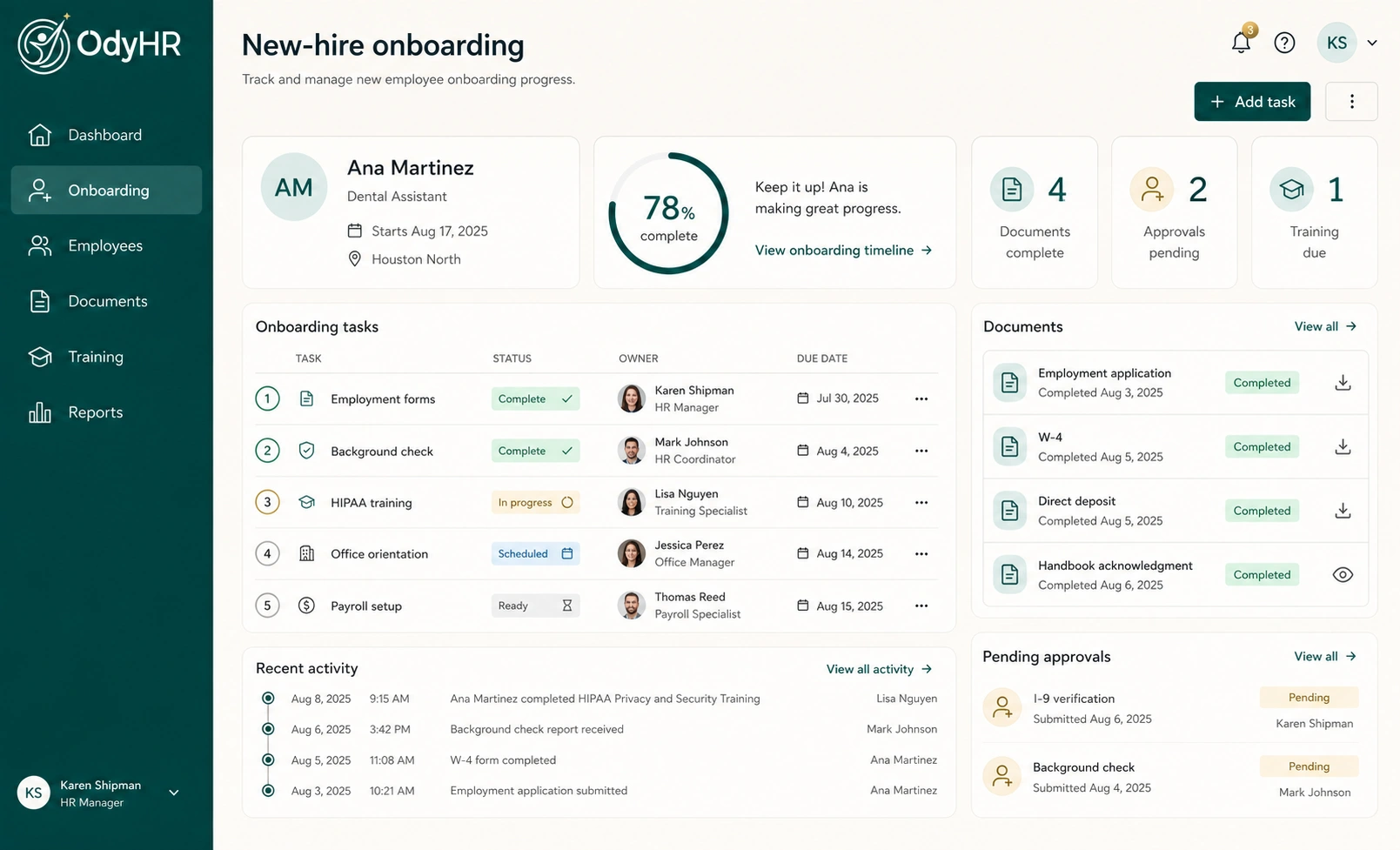
OdyHR's onboarding workflow brings tasks, documents, owners and due dates together. Those capabilities can help coordinate approved operational work, provided the organization first confirms suitable access and information-handling requirements.
For a workflow conversation, bring a fictional example showing the handoff from hiring to HR, equipment setup and the first check-in. Contact OdyHR to discuss fit and setup, leaving medical details and confidential employee records out of the inquiry.
AUTHORITATIVE REFERENCES