WORKPLACE SAFETY GUIDE
Damaged or Poorly Fitting PPE: An Employee Reporting Checklist
Give employees a clear way to report damaged or poorly fitting PPE, reach the right supervisor and confirm appropriate replacement and training follow-up.

Important: This guide provides general operational information, not legal advice. Employment requirements vary by location, industry, workforce, and situation. Confirm current requirements with qualified HR or legal professionals.
An employee notices a crack in assigned eye protection. Another finds that issued gloves no longer fit correctly. Both need a clear answer to the same questions: what should I do now, whom should I contact and how will suitable equipment reach me?
A PPE reporting procedure should answer those questions before the next shift. It should connect an employee's concern to someone who can assess the issue and arrange the appropriate response.
For general industry, OSHA's PPE standard requires equipment selection based on workplace hazards, includes proper-fit requirements and prohibits using defective or damaged PPE. OSHA 29 CFR 1910.132.
The checklist below addresses communication and follow-through in workplaces such as warehouses and manufacturing facilities. Your qualified safety lead should adapt it to the equipment, hazards and applicable rules. Respiratory protection, electrical protective equipment and other specialized programs need their own requirements; this article does not provide a technical inspection or selection procedure.
Explain the immediate response
Employees should know how to respond when they find damage, a fit problem or another concern about required protection. Include the response in the job's approved training and make it accessible where the work happens.
Do not start or continue hazard-exposed work without required, suitable protection. Follow the workplace's safe stopping or withdrawal procedure and contact the responsible supervisor. If an injury, exposure or immediate emergency has occurred, use the relevant emergency process first.
Make it clear that reporting a problem does not authorize an employee to tape over damage, modify equipment or choose a substitute independently. Whether equipment can be adjusted, repaired, replaced or used for another task belongs with the appropriate safety owner and applicable manufacturer instructions.
For operations where stopping requires a controlled sequence, the job-specific procedure must explain that sequence. A generic HR checklist should never instruct someone to improvise around machinery or an active process.
Give each shift a real contact
“Tell your supervisor” needs enough detail to work at six in the morning, during a weekend shift and when the usual manager is absent.
Specify the normal contact, the backup and the approved communication channel. Explain how an employee knows the concern has reached someone able to act. A message in an unattended inbox leaves the problem unresolved.
OSHA's PPE guide identifies informing a supervisor about repair or replacement needs as an employee responsibility and describes employer responsibilities for providing, maintaining and training on PPE. OSHA Personal Protective Equipment guide.
Build the route around your operation. A small shop may use a named supervisor and backup. A larger facility may involve a safety coordinator and controlled equipment issue point. Employees need the actual route, rather than a list of departments to try.
Capture the information needed to act
A short report can help the reviewer identify the item and the affected work. Adapt these suggested fields to your workplace:
- Equipment type and identifying information, where available
- Employee's work area and the task that needs the protection
- What was observed, using factual language
- When the issue was noticed
- Whether the item has been removed from use under the approved process
- Supervisor contacted and the next action communicated
Distinguish an observation from a conclusion. “The strap no longer holds its adjustment” is useful information. A report does not need an employee's unsupported technical explanation of why it failed.
Photographs may help only when workplace rules permit them and they can be taken safely. Never ask someone to handle contaminated equipment, re-enter a hazardous area or repeat an unsafe activity to produce a better picture.
Keep unsuitable equipment out of circulation
Your approved process should specify how affected equipment is identified, handled and held for review or disposal. Tell employees where it belongs and who can decide what happens next.
Avoid an arrangement where a damaged item goes back into a shared cabinet and another person unknowingly selects it. Where equipment could be contaminated or otherwise hazardous, follow the relevant handling procedure rather than creating a general-purpose returns bin.
The replacement handoff also needs clarity. Confirm that the issued item is the one approved for the task and that fit or compatibility concerns have been addressed by the appropriate person. A different brand or model may need additional review; appearance alone does not establish equivalent protection.
Check understanding when equipment changes
Employees need to know how to use the equipment actually provided. Under the applicable parts of OSHA's general-industry PPE standard, training includes use, limitations and care, and employees must demonstrate understanding and proper use before work requiring that PPE. Changes that make previous training obsolete can require retraining. OSHA PPE training requirements.
A replacement request can therefore lead to more than an issue-counter transaction. The safety or training owner should determine whether instruction, a demonstration or another check is needed. Record that follow-up according to the approved program.
Use a fictional scenario during training: an employee reports damaged eye protection, the usual supervisor is absent and the approved replacement is unavailable. Ask the team to identify the backup contact and safe next step. Any unclear answer reveals a gap the procedure owner can resolve before a real event.
Close the report and review repeated problems
The person who reported the issue should know the outcome. Confirm what was provided or decided, who checked the relevant follow-up and whether anything remains open.
Review repeated reports for practical problems such as unavailable sizes, confusing issue procedures or equipment that repeatedly needs attention. Refer those patterns to the safety lead for assessment. Avoid assuming that repeated requests automatically show employee misuse.
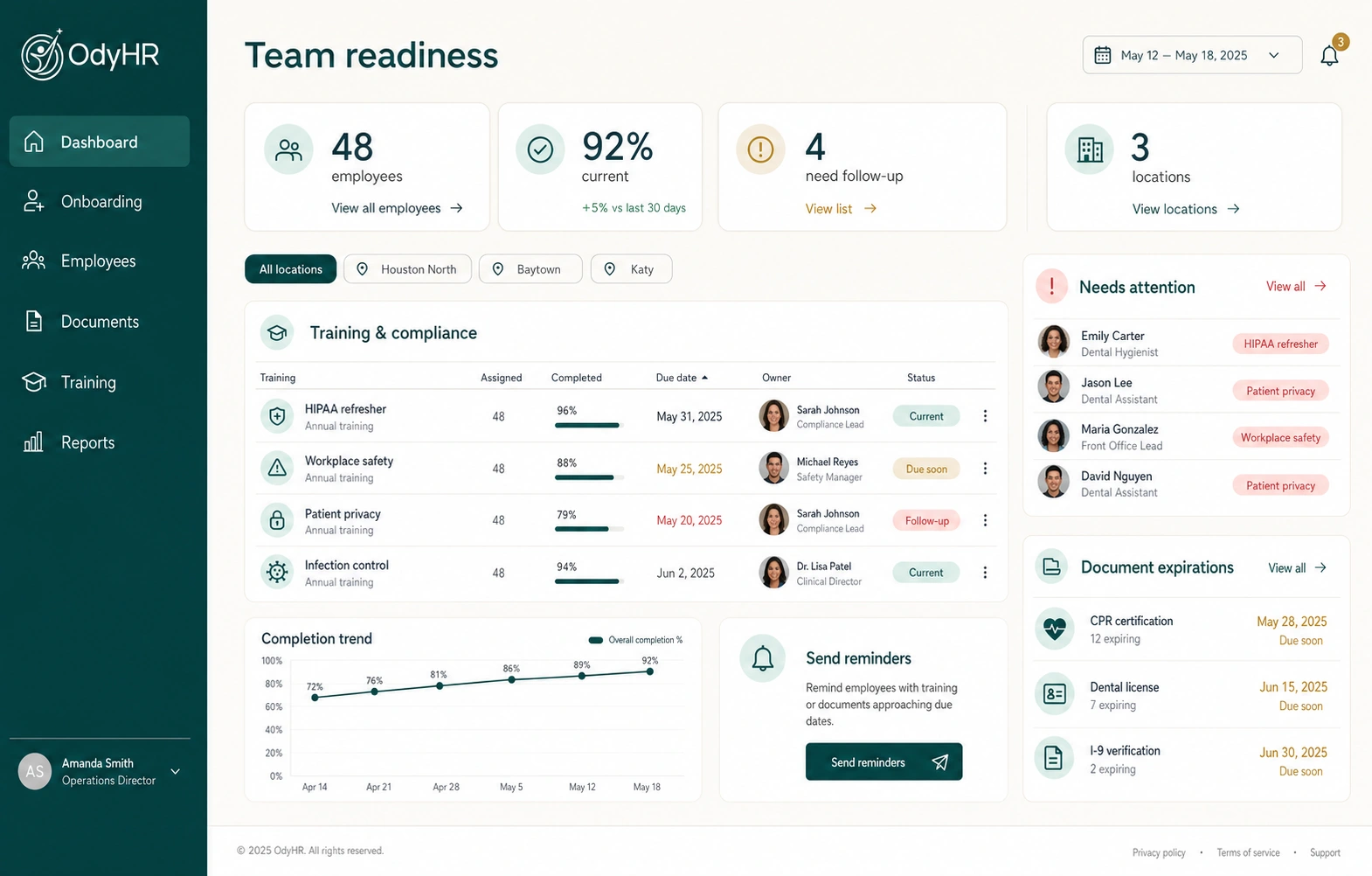
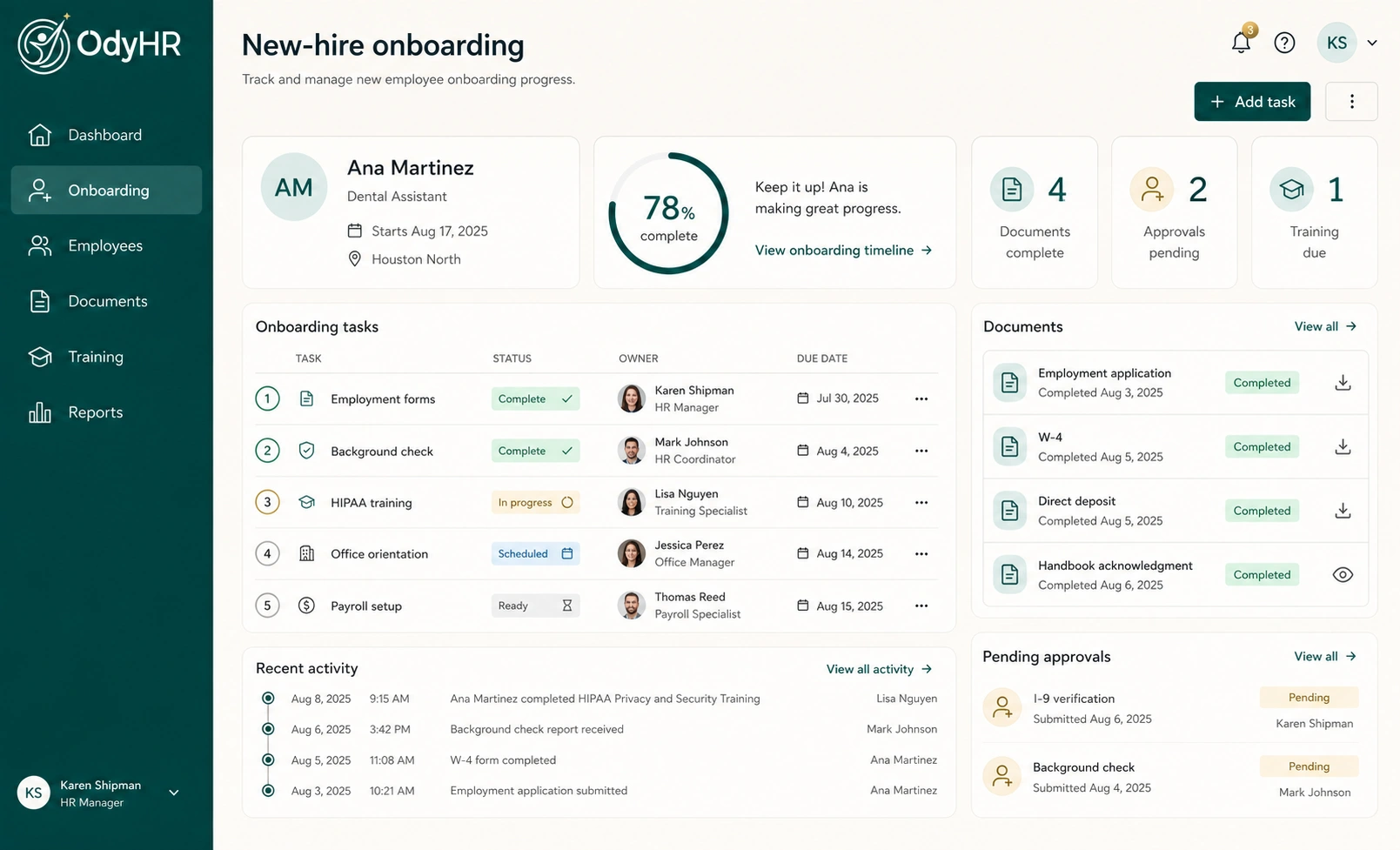
OdyHR can help organize employee training completion and follow-up. Keep equipment selection and safety decisions with the qualified people responsible for them. To discuss how approved training responsibilities might fit your team's workflow, contact OdyHR with a fictional example and your locations and team size.
AUTHORITATIVE REFERENCES