PERFORMANCE GUIDE
Employee Write-Up Form: Free Word and Fillable PDF Template
A two-page write-up form that keeps the record factual: what happened, which expectation applies, what the employee said, and what happens next.
FREE DOWNLOAD · NO SIGNUP
Employee write-up form
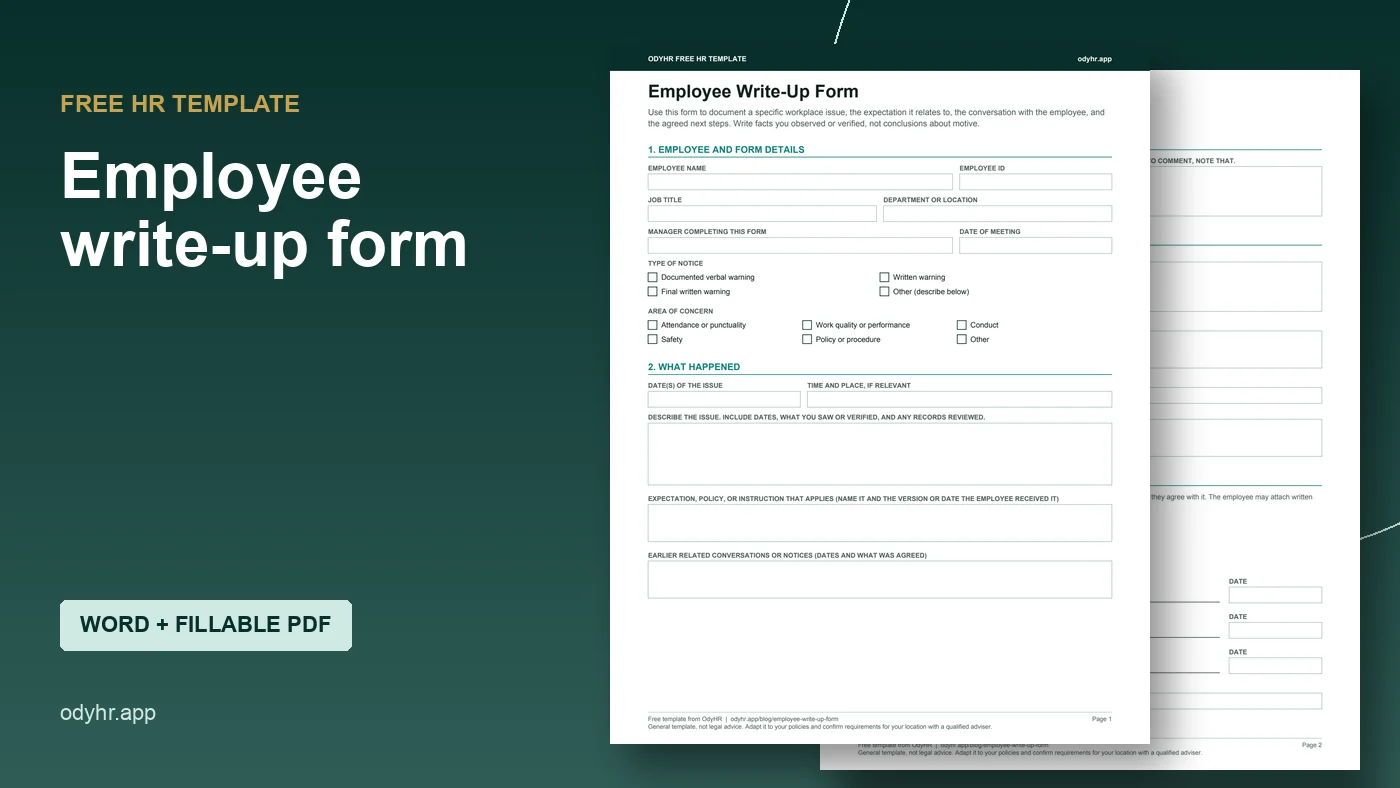
Two-page form with notice type, facts, policy, employee response, improvement plan and signatures.
Important: This guide provides general operational information, not legal advice. Employment requirements vary by location, industry, workforce, and situation. Confirm current requirements with qualified HR or legal professionals.
WHAT YOU GET
A write-up form built around facts, not adjectives
An employee write-up form records a specific problem, the expectation it relates to, what the employee said, and what happens next. It is the written step in a progressive discipline process, after a conversation has not fixed the issue or when the issue is serious enough to document right away.
The free form (Word and fillable PDF, two pages) covers:
- Employee and meeting details, and the type of notice: documented verbal, written, final written, or other
- Area of concern: attendance, work quality, conduct, safety, policy, other
- What happened, the policy or instruction that applies, and earlier related conversations
- The employee’s response, in their words
- An improvement plan with support, a follow-up date and an owner
- Signatures, with wording that makes clear a signature means receipt, not agreement
PREVIEW
The sections on page one
Employee Write-Up Form
1. Employee and form details
Type of notice
2. What happened
HOW TO FILL IT IN
Write it so a stranger could follow it
Imagine someone who was not there reading the form a year from now. They should be able to tell what happened, what rule applied, and what the employee was asked to do.
- 01
Describe behavior, not character. “Arrived at 9:40 on October 6, 8 and 13; shift starts at 9:00” is useful. “Is unreliable” is not.
- 02
Name the expectation. Point to the policy, the schedule, or the instruction, and when the employee received it. If there was no clear expectation, fix that first.
- 03
List earlier conversations. Dates and what was agreed. If this is the first time it was raised, say so.
- 04
Let the employee respond. Write down their account, even if you disagree with it. Context sometimes changes the next step, for example a scheduling conflict or a medical issue that needs to go to HR.
- 05
Make the plan checkable. State what needs to change, what support you will provide, and the follow-up date. Then hold the follow-up meeting.
- 06
Sign, copy, file. Give the employee a copy and file the original in their employee record. If they decline to sign, note the date and who was present.
For day-to-day notes that come before a formal write-up, use the performance documentation guide and log.
FICTIONAL WORKED EXAMPLE
Vague versus specific
“Alex has a bad attitude and keeps coming in late. This needs to stop.”
“Alex clocked in at 9:40, 9:25 and 9:50 on October 6, 8 and 13. Shift start is 9:00 per the posted schedule Alex confirmed on September 2. We discussed late arrivals on September 29 and agreed Alex would text the shift lead before 8:45 if running late. No texts were received.”
In the fictional example, Alex explains that a bus route changed. The manager notes it, offers a 9:30 start for two weeks while Alex sorts out transport, and sets a follow-up for October 27. The plan reads: “Arrive by the agreed start time, or text the shift lead before 8:45.” Both can tell whether that happened.
BEFORE YOU USE IT
Check these with HR or an adviser
- Your own handbook or discipline policy, and any union or employment agreement, may set the steps you must follow.
- Apply the same standard to everyone in the same situation. Inconsistent discipline is a common source of discrimination claims.
- If the employee recently complained about discrimination, harassment, pay or safety, or asked for leave or an accommodation, talk to HR or counsel before acting.
- Some states give employees the right to see or respond to their personnel file.
This form is a general template, not legal advice, and using it does not protect a decision on its own.
KEEP IT WITH THE REST OF THE RECORD
Where OdyHR fits
A write-up is only useful if you can find it later next to the evaluations, notes and training that explain the full picture. Paper forms in a drawer and PDFs in someone’s inbox make that hard.
In OdyHR, documents live in each employee’s record alongside their evaluations, training and work history, so a manager or owner can see the whole history in one place. OdyHR does not decide whether discipline is appropriate or lawful. That judgment stays with you and your adviser.
QUESTIONS
Write-up form FAQ
What is the difference between a verbal and a written warning?
A verbal warning is a conversation, usually documented with a short note. A written warning is a formal document the employee receives and signs. Many businesses use both as steps in a progressive discipline policy, but the steps are set by your own policy.
Does an employee have to sign a write-up?
Asking for a signature confirms the employee received the form. They may refuse. If they do, write the date, note that they declined, and have a second person (often HR) confirm it was delivered.
Can the employee add their own comments?
Yes, and you should let them. The form has a response section and a checkbox for comments attached on a separate page.
How long should I keep a write-up?
Keep it in the employee’s personnel file. Federal rules set minimum retention periods for many personnel records, and state rules can be longer. If a charge or lawsuit is filed, keep everything related to it until it is fully resolved.
Should I use a write-up for a first offense?
It depends on how serious it is and on your policy. Most minor issues start with a conversation and a note. Safety violations or serious misconduct may go straight to a written or final warning.
AUTHORITATIVE REFERENCES